
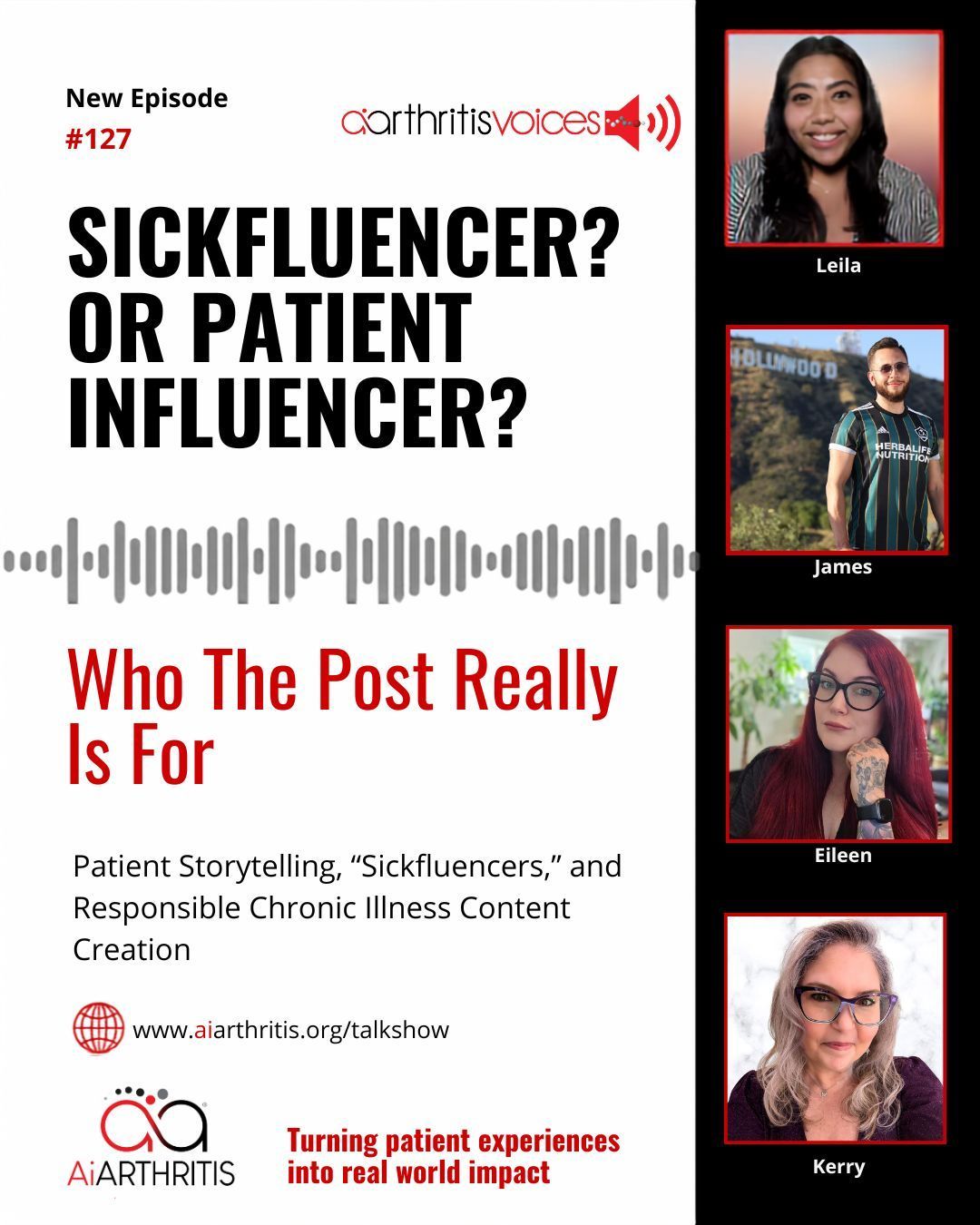
Sickfluencer or Patient Influencer? Who the Post Is Really For
AiArthritis 360° Podcast · Episode 127 · Step 2: Identify
Aired
November 1, 2026 ·
35:45
With Leila P.L. Valete, Eileen Davidson, James Hollens and Kerry Wong
Four co-hosts living with autoimmune and autoinflammatory arthritis diseases respond to a Telegraph article that labeled chronic illness creators "sickfluencers." They share why they started posting about their illness, the real-world harm the label can cause, and where they draw the line on making money from their content.
Watch or listen
The full episode
Podbean embed url
In this episode
What questions does this episode answer?
Why do people with chronic illness share their experiences online?
The co-hosts describe it as a release, a way to feel less alone, and a way to pay forward the help they got from other patients' posts. James started posting to show that men live with these diseases too, and Eileen to push back on people who said she didn't look sick.
Listen from 04:14
What is the "sickfluencer" article?
A Telegraph article that, the co-hosts say, calls chronic illness creators "sickfluencers," suggests many are faking illness for attention or money, and describes illness as a "social contagion."
Listen from 12:14
How can the "sickfluencer" label cause harm offline?
The co-hosts worry it fuels disbelief and harassment, and that online hate can spill into real life. Kerry names work accommodations, disability benefits, privacy and personal safety as things it could affect.
Listen from 20:34
Why might someone use a mobility aid one day and not the next?
Many of these conditions vary from day to day. Kerry describes walking on her own some days and needing a mobility aid or scooter on others, depending on the distance and how the previous day went.
Listen from 20:34
Is it okay for chronic illness creators to make money from their content?
The co-hosts say yes: their time and energy have value, and many people with these diseases can't work traditional jobs. The lines they draw are telling the truth, being clear that they share personal experience rather than medical advice, and not selling products with harmful or unproven health claims.
Listen from 25:25
Key takeaways
What did the community say?
74%
In an AiArthritis Instagram poll, 74% said chronic illness creators helped them feel informed, understood or less alone.
85%
85% said they had felt judged or questioned for sharing their illness online.
Top concern about the "sickfluencer" narrative: medical misinformation (31%), then patient disbelief and monetization (25% each), then online harassment (19%).
The co-hosts' line on monetization: be transparent, tell the truth, and avoid harmful health claims.
Poll results come from AiArthritis community polls on Instagram, not formal research.
Have you ever felt judged for sharing your illness online? Tell us what happened and what helped.
When we share what we’ve experienced and what helped, we learn from each other. Many experiences together also help AiArthritis find the challenges our resources, programs and tools should address.
Interested in becoming a co-host? Email leila@aiarthritis.org.
Want to suggest a topic or become a peer partner? Fill out our community response form.
who is at the table
Who hosts this episode?
Leila P.L. Valete
Health Education Manager, living with lupus and Sjögren's disease
Eileen Davidson
Educational Media Assistant, living with rheumatoid arthritis and non-radiographic axial spondyloarthritis
james hollens
living with rheumatoid arthritis and ankylosing spondylitis
kerry wong
living with sarcoidosis, rheumatoid arthritis and Sjögren's
transcript
read the full conversation
Episode 127 Transcript
00:00 Leila P.L. Valete: Hello and welcome to the AiArthritis 360 Podcast. This is the official podcast of the International Foundation for Autoimmune and Autoinflammatory Arthritis, or AiArthritis for short. My name is Leila P.L. Valete, and I am one of your co-hosts today. I'm a person living with lupus and Sjögren's disease, and I am the Health Education Manager here at AiArthritis. Today I'm joined by three amazing co-hosts. Eileen, do you want to start by introducing yourself?
00:28 Eileen Davidson: I'm Eileen Davidson, and on the internet I go by Chronic Eileen. I'm also a contractor with AiArthritis as the Educational Media Assistant. I'm a rheumatoid arthritis and non-radiographic axial spondyloarthritis advocate, a blogger, an Instagrammer, all those fun social media things. I'm also a patient partner in research, and it's a pleasure to be here to talk about this topic, because it caught my eye.
00:57 Leila P.L. Valete: Definitely. James?
00:59 James Hollens: Hi everyone, my name's James Hollens. I live with rheumatoid arthritis and ankylosing spondylitis. I'm from London, and I'm a new co-host here at AiArthritis. It seems you guys aren't sick of me talking about being sick just yet, so hopefully you'll see a bit more of me. I'm very honored to be here with you lovely people today.
01:20 Leila P.L. Valete: Go ahead, Kerry.
01:21 Kerry Wong: I'm Kerry Wong, also known as the butterfly of Float Like a Buttahfly. I'm a writer, educator, and patient advocate living with a rare disease called sarcoidosis, plus rheumatoid arthritis, Sjögren's, and honestly a big old list of conditions that my rheumatologist now just calls "autoimmune soup." I have a regular column at Sarcoidosis News, and I do as much as I can to share my experience to help support and empower other patients.
01:50 Leila P.L. Valete: We have a very special topic for you today. There's been a narrative going around the community about an article that used the word "sickfluencer," what that says about chronic illness content creators, and what the writer thought the consequences were for the rest of society. We're here to talk about that, and about why we tell our stories. Especially here at AiArthritis, we know how important it is to be able to share lived experience. It's one of the main things we do, and we've been talking with you all about it over the past few months.
We're going to talk about how important patient storytelling is, how important it is to combat misinformation, and how important transparency is when it comes to monetization. We want to set the tone for a respectful discussion, while remembering that these are real people's lives the article was attacking. All of us live those lives and have something to say about it.
So I really want to hear the co-hosts' opinions and what they've heard from the community. We don't need to call out specific people, but we can reference articles and posts we've seen. This was such a hot topic that we wanted to put it on the table. Thank you, Kerry and Eileen, for bringing it up. You each raised it separately, one day apart, and it became clear this needed to be the topic for our next episode.
Like the last few episodes, we put out a few Instagram polls before this recording to ask the community what they thought, and we'll talk about those during the episode. But first: why did you all start sharing your chronic illness experiences publicly, and has that purpose changed over time? What first made you start talking about your story?
04:14 Kerry Wong: I'll go. I started back in 2010. I was going through a lot in my life. Part of it was trying to figure out what was wrong with me physically, and part of it was things at home and at work. I started a blog about issues with self-esteem, going through challenges, and trying to come out the other side.
It was partly cathartic for me, and partly knowing I'm not the only one having problems, so if I could help somebody else, that would be great. As my health issues became a bigger part of my life, they became a bigger part of my blog, then its main focus, which led to my column, to my book, a collection of rare disease stories, and to everything I do now. When I was really struggling to figure everything out, I found a couple of other blogs and pages, and they helped me. They helped me know I wasn't alone and understand things a little better, and they did so much for me that I wanted to pay it forward. Now there are even more people who need it and more people who are struggling, and if I can help them the way others helped me, I want to do that.
05:43 James Hollens: I call it coming out of the chronic closet, back in 2020. Before that I was a very typical man: hiding my feelings, not opening up about the conditions I was living with, not even telling anybody I had arthritis, because I still believed it was an old person's disease. I thought I was the only one unlucky enough to have a condition like that at my age, like I was gatecrashing the pensioners' club.
Then during the pandemic I had to shield, because I was on strong immunosuppressing drugs. I was stuck inside, didn't have a job, didn't have much to do, so I reached out to an arthritis charity, Arthritis UK, and asked if I could help with anything, something to do that wasn't playing Xbox. I thought they'd give me some admin, but they wanted to hear my story. I told them, and they asked, "Can we write an article about this?"
I was hesitant at first, because I was still in denial about the arthritis. My friends didn't really know. They'd seen me on crutches sometimes, but I think they assumed it was a football injury, because I was a 21-year-old wobbling around town on sticks. Then I saw the reaction the article got. A lot of people messaged me, particularly men in my position, saying, "I've been going through this too. It's so good to see another man speaking about it." Seeing that community and all those connections, I started building friendships with people going through the same thing, and that inspired me to keep going.
This world is very female-dominated, which is amazing, you're all smashing it, but chronic illness doesn't discriminate. Loads of men are going through this, but if you looked online you wouldn't see that. That urged me to do more, to add some male representation and encourage other men to come forward and talk about their feelings. That's a hard thing for us to do, but chronic illness is full of feelings, and it's better to get them out. Once I started opening up, it helped me come to terms with my own situation, and hopefully I can help other people in that situation too.
08:04 Eileen Davidson: They've covered a lot of the reasons we share our stories online, and I relate to both of their stories. For me, I'd add that I was angry. People didn't understand what I was going through because I didn't look sick. I was 29. One day I could do something, and the next day I couldn't. There are so many stigmas, misconceptions, and so much misinformation online about the diseases we live with. People would say, "That's not serious," or "At least you don't have cancer," all these ignorant sayings.
A lot of my spark to create content, starting with a blog and then social media, was that what I was experiencing didn't match what other people were telling me. When I looked up resources on my condition, they told me it was serious. So I wanted to push back on the people who say autoimmune and autoinflammatory arthritis diseases aren't serious, and prove them wrong.
09:18 Leila P.L. Valete: You all make really great points, and I think the central idea is not feeling alone. Having these diseases can feel incredibly isolating, especially within your own circle of family, friends, and work, because nobody around you has them. Thank goodness for the digital age that we can connect with so many people. We're in different countries right now, and Kerry and I are on different sides of the country. The digital age has brought so much to our community.
One of the questions in our outline asks, "Did you set out to be an advocate?" I don't want to speak for all of you, but from your stories, I don't think any of you set out to be one. The second question is, "Has your content helped people?" I can answer that one for all of you: I know it has. I've seen many people comment on AiArthritis posts about how much Eileen has changed their disease journey. Like James said, being a man in this space has probably had so much impact. And Kerry, with sarcoidosis being such a tough rare disease, on top of everything else, you have so much to give others. From the community, thank you all for being so candid and putting yourselves out there, because that isn't easy. A round of applause for all of you.
11:01 James Hollens: Don't forget to give yourself your flowers too, Leila. You're doing amazing stuff as well.
11:06 Leila P.L. Valete: Thank you.
11:07 Kerry Wong: You beat me to it, but I was going to say the same. Absolutely, Leila, you as well.
11:11 Leila P.L. Valete: Thank you, I really appreciate it. From the community, our first poll asked: have chronic illness creators helped you feel informed, understood, or less alone? 74% said yes, 10% said no, and 16% said unsure. So the vast majority said yes. Some people don't care about other people's experiences, and that's fine too, to each their own. If someone else's experience doesn't affect yours, you stay in your own lane. But for most people, chronic illness creators have helped, and that shows how important it is for us to keep telling our stories.
Would one of you like to explain a bit more about what the sickfluencer article said, and what the community has been saying about it?
12:14 Kerry Wong: Sure. I actually first found it through other people's responses. Someone named Aiden wrote about it on Substack, and Michelle Reed wrote a piece on LinkedIn called "What the Sickfluencer Article Gets Wrong." The article itself was in The Telegraph. To shrink it down, it's about those of us who live with chronic illnesses and share our stories and information to help and learn from each other. Just calling us "sickfluencers" from the start makes me cringe. It goes on to suggest that a lot of it is faking for attention, and it refers to a "social contagion." I believe the article was originally titled something like "How Having a Disability Became Cool."
It's belittling, demeaning, and dismissive of people like us who are living with life-altering diagnoses. It suggests many of us are faking it, trying to get attention or make money, and that other people then pretend to be sick, or make themselves sick, because they want to be "cool like us." That's just not reality. It's hurtful to us individually, and it's harmful to society. It really needs a reality check.
What's great is that a lot of people in the chronic illness community are giving that reality check and explaining what's really going on. I almost didn't want to keep bringing it up, because I don't want to give it more attention. But somebody out there is only going to hear that message, and it could devastate them and keep them from seeking help. That vulnerable person needs to hear many more voices like ours saying, "What you're going through is real. Your feelings and your experience matter." They need to hear a lot more of us than that one small but loud, harmful voice.
15:05 Eileen Davidson: I'd like to add that, in my opinion, The Telegraph is known for rage-baiting and chasing views, so it isn't a reliable source of information for me. The journalist went to people in the chronic illness community and asked questions as if she were writing about their online advocacy. Instead, she decided that stirring up drama and pushing a false "sickfluencer" narrative would get more views and spark more conversation.
15:57 James Hollens: Following on from that, I think they live off fear-mongering, and we're just the group they decided to pick on this week. I love a pun, but "sickfluencer" is a weak one. What annoys me most is the idea that we're making illness look cool. It wasn't cool when I was in a hospital bed unable to move, waiting to find out what was happening to my body. It wasn't cool when I was learning to walk again, twice. What was cool was finding a community I could relate to, where I could talk about feelings that people in my day-to-day life wouldn't understand. So yes, it is cool that we're doing it.
17:04 Leila P.L. Valete: Heaven forbid we try to turn something that's been such a struggle into something positive, like creating a community. If the article was meant to rage-bait, it definitely put our community up in arms. I hate to say it, but it really does feel like we need to defend ourselves. So this episode is about letting everyone know why it's so important for us to keep telling our stories.
There are a few more questions to get through so we can hear what the community is saying. One of the biggest is what concerns people about this narrative being out in the public eye, in major publications. We asked, "What concerns you most about the sickfluencer narrative?" 25% said patient disbelief, 31% said medical misinformation, 25% said monetization, and 19% said online harassment. Unfortunately, with more eyes on the community because of publications like this, people can become more hostile online toward creators. Kerry and I were talking before this about the WNBA, and I think it's a good comparison. Players have said that with the spotlight on the league over the past two years, their DMs are now full of racist, sexist, and homophobic messages they never used to get.
19:01 Kerry Wong: Transformative.
19:02 Leila P.L. Valete: Exactly. And I see Eileen has something to say too.
19:06 Eileen Davidson: Not to be a conspiracy theorist, but I think a lot of it is bots, rage-baiting bots. Over the last few years I've noticed a lot more hate online coming from bot profiles. We need to be able to identify those bots and just ignore them.
19:30 Leila P.L. Valete: Yes, that's a big thing too. Go ahead, James.
19:34 James Hollens: I'm not sure if this happened on your side of the pond, but during the pandemic there was a witch hunt on Reddit against young women who talked about their chronic illnesses. I don't know if it was linked to an article, but things like this could reignite that fire. I know a lot of young content creators and advocates who stopped posting because of the abuse they got online. People posted untrue stories about them and shared their pictures saying, "She's faking it. She doesn't need that walking aid." We have it hard enough as it is. Adding cyberbullying on top of that goes way too far, and articles like this can encourage people to do it, which can have a big effect on people's mental health.
20:31 Leila P.L. Valete: Yes. Go ahead, Kerry.
20:34 Kerry Wong: I want to jump on that. The example of "she doesn't really need a cane because I saw her walking without it once" is a prime example of why we need to keep sharing. A lot of our conditions vary. Sometimes I can walk on my own, and sometimes I need a mobility aid. Depending on the distance, what I did the day before, or what's coming up, I might need a mobility scooter, and somebody might see me on it.
I used to worry that people would see me stand up and think, "She's faking it." I've been doing this a long time and I've built up the confidence to say, "This is me. Take it or leave it." But other people are feeling that worry, and the outside world needs to see more of our stories that say it's not all or nothing. Some people sometimes use an aid and sometimes don't. People who aren't living with this need to learn that's reality. People who are need to see that it's okay to use it on the days you need it, and okay not to on the days you don't.
On the WNBA comparison: a lot of that hate may be bots, but a lot of it has also come into the real world. I've been at a game with protesters outside, and people have come into stadiums to intimidate fans and players. Something that starts with bots talking about people with chronic illnesses can be taken a step further into real life. For people who need accommodations at work, it could affect their ability to get them. For people who can't work and are on disability, it could affect their benefits. Not to mention people's personal safety, security, privacy, and their ability to be at peace with what they're already going through. Even if some of it starts as rage bait or bots, it ends up having real-life consequences.
23:20 Leila P.L. Valete: Definitely. It gives people encouragement to act on their impulses because other people are doing it too. That ties into another poll question: "Have you ever felt judged or questioned for sharing your illness experience online?" 85% said yes and 15% said no. And it's not just online, it happens in person too. Sometimes even the person with the illness wonders, "Am I being dramatic? Am I making this up in my head?" Knowing that other people's abilities fluctuate can really help. My doctor has never talked with me about how different my disease is day to day, or what I might need on some days and not others. That never comes up.
What the outside world doesn't see is that we might only see our doctors and healthcare team for 15 minutes every few months. The rest of the time, we're banding together and helping each other get through. So you're not just attacking individual creators you think are "sickfluencers," you're attacking the whole community.
Before we wrap up, I want to address monetization. As people living with these illnesses, like Kerry said, many people can't work regular jobs, like standing all day in retail or sitting in the same spot in an office for eight and a half hours. A lot of people need to monetize their content just to survive. So what's the responsible way to approach monetization in content creation? Are there boundaries? Is there a line when it comes to talking about your disease and making money from it?
25:25 Eileen Davidson: I'll jump in on this one, because I'm proud to say I've made a few bucks with my content creation. In fact, I just got a notification from Facebook that they have $100 for me. Is that a problem? No. It's the same thing The Telegraph is doing, earning money from views, except my content is helping people and isn't trying to hurt anyone.
There is a line, though. If you can build a community and make money from views, sponsorships, paid posts, all of that, that's awesome. It gives people like me, Kerry, and James a platform and the ability to keep doing what we do, and chronic illness costs a lot. I'll make money from my writing, my content creation, and my consulting, but I won't make money selling supplements or leggings or whatever. Nordic walking poles? Okay, cool, there's actual research to back that up. I might promote programs I know will help people. So it really depends on what you're promoting to your audience. I'm not trying to sell anything, except sometimes I make cool shirts, which Kerry bought, because it's fun.
My advocacy and content creation is my release, my creativity, my art. Is it for attention? No. Part of it is for me, because living with chronic illness is very difficult and we need that release. Like James said, a lot of men hold that in, so I really admire James for being so open. I think he's really influencing other men to say, "This is what we've got. Deal with it."
27:39 Leila P.L. Valete: Any more thoughts on monetization?
27:40 Kerry Wong: Yes, it's okay to make money from the things we do. Our very limited time and energy is still valuable. Having an illness doesn't make us worth any less. We still have value, and so does our time, our creations, and our thoughts. Some things I get paid for, and some things I choose to volunteer for, and that's okay. For me, the line is the truth, plain and simple. I'm not a doctor and I'm not giving medical advice. I'm a patient sharing my experience, and what I tell you is the truth: what I've lived, what I've learned, and what I know in my heart. I wouldn't make anything up or exaggerate. It's that simple. The line is the truth.
28:42 James Hollens: I think it's important to remember that our audience is probably more vulnerable than the average audience, so we need to be more careful. As long as no one is being harmed, making money is fine. Views, for example, come through the platform, so no one is paying for them. And like Eileen said, I'd still make content as a release anyway, it's not necessarily about money.
But if you're selling things that could harm people, like telling people an exercise program will cure their arthritis, that's where you have to draw the line. If you're selling a product aimed at people with health problems, it needs to actually help, or you need a lot more disclaimers. Even when I post about things that help me manage my condition, I always make it clear that it's what works for me, because everyone's body is different. There's no one-size-fits-all. You have to be very careful with your wording.
At the same time, nobody puts reality TV stars selling miracle teas under the microscope the same way. We just have to be more careful, because the whole point of what we do is to support people with chronic illness. We want to help each other, not benefit at someone else's expense. That's the most important thing for me.
30:18 Leila P.L. Valete: Definitely. As AiArthritis moves into this new season of lived experience sharing and collection being the main part of how we create our resources and how we show up online, it's for the community, for those living with our diseases. The more information we get from people living with our diseases, the more we can pull out themes, find knowledge gaps in our community, and decide what we need to discuss. That's exactly what we'll keep doing on the AiArthritis 360 Podcast: collecting input from the community to see which topics we need to talk about, what else we need to address, and what you want to know. Let us know. We're here for you.
If you're listening because you saw the buzzword "sickfluencer" and wondered what was happening, welcome. We are AiArthritis, and we want to help you elevate your story and your experience, so that the hard experiences you've had, in the doctor's office, in the hospital, on the floor of your bathroom, can still help the next patient who comes along. That's our goal.
Thank you, all three of you, for being here and lending your experience to this subject. It's been a hot topic in the community, so we knew we had to address it and make sure people know how important it is to keep sharing their stories. If you're out there telling your story like James, Kerry, or Eileen, and you want to get more involved with AiArthritis, we're still recruiting co-hosts for this podcast. Let us know if there's anything you want us to talk about or if you're interested in being a co-host. We'll also be looking for peer partners to be our eyes and ears in the community and let us know what people are talking about. If that interests you, reach out through our community response form.
To close, thank you all again for sharing your experience. Lived experiences are so valuable, and accurate information and accountability matter too. Those things don't have to compete. We want people living with AiArthritis diseases to feel empowered to share their stories while encouraging thoughtful, responsible conversations about our health online. At AiArthritis, we don't just represent the patient voice, we are the patient voice, and with your support we can amplify it even further. If you found value in this episode, please consider making a donation to help us keep producing these conversations, bringing all stakeholders to the table to discuss patient-identified issues and patient-infused solutions. Visit aiarthritis.org to help us make a difference together.
Thank you again for tuning in to this episode of the AiArthritis 360 Podcast. James, Kerry, Eileen, please let the audience know where they can find you and share any closing remarks.
34:11 James Hollens: Ladies first.
34:12 Kerry Wong: I'm Kerry Wong, the butterfly of Float Like a Buttahfly. You can find my column at Sarcoidosis News, and you can find me on Substack or Bluesky. Just look for Float Like a Buttahfly, but I spell it like a New Yorker says it: B-U-T-T-A-H. Or find me at @buttahflyk.
34:36 Eileen Davidson: I'm easy to find online as Chronic Eileen, E-I-L-E-E-N, not Irene, lots of people get that wrong. I'm also on the AiArthritis website.
34:48 James Hollens: And I'm James Hollens, that's my username on Instagram and TikTok. Come and have some fun on there if you want.
34:59 Leila P.L. Valete: Honestly, James's content is hilarious, you have to go check it out. I'm online at lupus.lifestyle.lei. I plan to start making more content about being a new mom with lupus and Sjögren's. It's taken me a little time to heal and be ready to talk about everything after becoming a new mom, so I hope to start sharing that soon. You can find AiArthritis at @IFAiArthritis on all social media platforms. That's a wrap. Thank you again, and we'll see you next month for the next episode of the AiArthritis 360 Podcast.
35:42 Kerry Wong: Thanks, everyone. Bye!
35:44 Eileen Davidson: Bye-bye!
start where you are
where are you with this?
Topics in this episode, and the pages for where you are right now.
where to next
where people go from here
WHERE CAN PATIENTS HAVE A VOICE?
How patients can find their voice and advocate for change across healthcare.
LOVE THE SHOW?
Your donation helps keep AiArthritis 360° Podcast on the air.
Page last updated: November 24, 2026.