


Ep 118: More Than a Smile: Oral Health in AiArthritis Diseases
AiArthritis Voices 360 Main, Full Episode 118
Air Date: February 8th 2026
This episode is a step 2, as outlined in our 6 Step Patient-Led Problem Solving Process.
Oral health is often treated as optional or cosmetic, but for people living with AiArthritis diseases, it can have a real impact on pain, fatigue, nutrition, and quality of life. In this episode, Leila and Bridget explore why oral health deserves a place in routine disease management and
why so many patients are never told their symptoms are disease related. The episode looks at how autoimmune conditions and common medications can affect the mouth, from dry mouth and gum inflammation to delayed healing and increased infection risk. It also breaks down the connection between oral health, the immune system, and systemic inflammation, helping patients better understand why issues can show up even when oral
hygiene is strong.
Join us on this episode to hear practical, gentle strategies for protecting oral health when saliva is reduced or sensitivity is high. The discussion emphasizes adaptation over perfection and reinforces that oral health challenges are not personal failures, but part of living with complex
chronic disease.
Episode Highlights:
- Why oral health is often overlooked and why it matters in autoimmune disease
- How inflammation, medications, and reduced saliva affect the mouth
- The link between oral health and conditions like Sjögren’s, rheumatoid arthritis, lupus, and scleroderma
- Gentle, realistic strategies to protect teeth and gums without causing more harm
Have questions about this episode or topics you want to hear us bring to the table?
Email us at podcast@aiarthritis.org
Donate to Support the Show: www.aiarthritis.org/donate
AiArthritis Voices 360 is produced by the International Foundation for Autoimmune and Autoinflammatory Arthritis. Visit us on the web at
www.aiarthritis.org/talkshow. Find us on Twitter, Instagram, TikTok, or Facebook (@IFAiArthritis) or email us (podcast@aiarthritis.org). Be sure to check out our top-rated show on
Feedspot!
Follow AiArthritis on all social media platforms
Who is at the table?
Leila P.L. Valete,AiArthritis Health Education Manager & Person Living with Lupus & Sjogren's
Bridget Dandaraw-Seritt, person living with AiArthritis disease, Advocates for Compassionate Therapy Now
-
Episode 118 Transcript
AiA Episode 118
===
[00:00:00] Welcome to AiArthritis Voices 360, the podcast solving today's most pressing issues in the AiArthritis community. We invite you all to the table, where together we face the daily challenges of autoimmune and autoinflammatory arthritis. Join our fellow patient co-hosts as they lead discussions in the patient community, as well as consult with stakeholders worldwide.
To solve the problems that matter most. Whether you are a loved one, a professional working in the field, or a person diagnosed with an AiArthritis disease, this podcast is for you. So pull up a chair and take a seat at the table.
Hello and welcome to AiArthritis Voices 360. This is the official talk show for the International Foundation. For autoimmune and autoinflammatory arthritis, or AiArthritis for short. My name is [00:01:00] Leila and I am one of your co-hosts. Today, I'm a person living with lupus and Sjogren's disease, and I'm the health education manager here at AiArthritis, and I am joined by one of our superstar volunteers and a very passionate advocate, Bridget Sarat.
And Bridget, why don't you tell the audience a little bit more about yourself what to be as you live with, et cetera. Hi, I'm Bridget Dandaraw-Seritt and I live with Ra, lupus, Sjogren's, aler Danlos and a bunch of other stuff. And I have been volunteering with AiArthritis for quite some time. Yes. Bridget is a part of a lot of our different volunteer opportunities, you know, including the talk show as well is very involved in the public policy and advocacy space.
And so if that's something that you're interested in, Bridget is actually part of one of our programs called AiAdvocates, where we are looking for advocates who wanna make a difference in the healthcare system when it has to do with ai, [00:02:00] arthritis diseases. And we're looking for people in every different state so that we can make sure that we are covering all of the different issues that are happening in the us.
So definitely check out our AiArthritis.org/advocacy page to get more information about becoming an AiAdvocate. 'cause that's something that's going to hopefully become a bigger program in 2026. We're super excited. You won't regret it. So, yes. All righty. And so today we are gonna be talking about oral health when it comes to ai, arthritis diseases, and I think that oral health is usually something that's kind of secondary, that people think about and maybe aren't thinking so much that when we're talking about these systemic diseases, that oral health is something that's, you know, important, but it actually really is and is very connected.
To you know, different parts of our autoimmune or autoinflammatory arthritis diseases. And so [00:03:00] that's why we're talking about oral health today. It's really important because some people may think that, you know, oral health is just important because it's cosmetic and, you know, you just wanna, you know, make sure that you, your teeth are there so that.
You don't look a certain way. But it's more than that. It really can, you know, even affect pain levels, fatigue, the ability to eat and hydrate properly. And again, of course, self-confidence and mental health. You know, many patients are never really told or educated about how common dry mouth, gum inflammation, and mouth sores are in our diseases.
And so we definitely want to make that known that, you know, these, this is not, you know, something separate from our autoimmune diseases, but a part of how systemic. All of our diseases are, and so both Bridget and I have had some experience with oral health when it [00:04:00] comes to our autoimmune diseases, but specifically with Sjogren's disease because one of the main symptoms of Sjogren's disease.
Is very dry mouth. And that's actually a lot of the time how patients find out that they have Sjogren's disease is from, you know, having such dry mouth and having issues with dental work and all of that kind of stuff. So. Bridget, why don't you kick us off and let us know a little bit about your oral health and how it's affected your, you and your life.
Oh, my, so these are not optional bones. They are very integrated with everything, including our immune systems and. I was diagnosed with Sjogren some time ago and put on gin, but it really didn't kick up until I had my neck fusion. And when I had my neck fusion, my mouth was so dry, I was peeling my tongue off the roof of my mouth every single morning.
And unfortunately [00:05:00] since then my teeth have just decayed completely. They've just crumbled from the bottoms up, you know, from underneath the gums, which is a standard Sjogren's. I'm eating your teeth kind of moment. So that has been very wild just in itself. And once you have. Neck fusion. Having oral surgery becomes a high risk, especially if you have a high level cervical fusion.
So I was unable to get a lot of those things pulled. You're not allowed to have dental work for at least a year after. The surgery and generally sometimes more because it can cause infections, it can cause flares, it can cause all sorts of issues. It can even infect other joints that are replaced, like my shoulder joint.
Every time I have something pulled, I have to. Have antibiotics and I have to really watch because joints that have been replaced in my [00:06:00] body for years, like my shoulder could just randomly become infected. So I've learned a lot having to deal with Sjogren's. My, my teeth are not really real. I have no molars in the back now, and the rest of them all need to be pulled that are in there.
So it's definitely been a journey. Yeah, absolutely. And I'm in a lot of these different Sjogren's Facebook groups and you know, things like that where there's a, I feel like half of the posts have to do sometimes with teeth and with oral health and everything that's going on and with me that this was actually the way that I found out that I had Sjogren's was how, with how dry my mouth was.
And after, you know, two or three years of shelling out. A thousand, 2000, $3,000 out of pocket for. For dental work, you know, crowns and cavities and all of these different things. It's like a constant cycle that we're always on. And even thinking about it, [00:07:00] back in the day when I was when I was a kid, I would go to the dentist and have 10 cavities and being like, why?
Like my mom's like, you brush your teeth every day. What's happening? Why are you having so many cavities? Then this was probably when I was like seven or eight years old, so it was kind of like. All of these things were happening from the very beginning and we had no idea like what it was caused by until I was 26 years old.
And so I think that, yeah, that was really tough and a lot of, just finding out that, you know, there's so much that you have to pay for because dental insurance in this company, I mean this country really sucks. Yes, it does not cover much. Even when I had double coverage, it was like, you know, they'll cover $1,500 total and then I'm still left with $3,000 to Yes, to pay out of pocket, and I was so expensive.
It's so expensive. And as patients, we already have so many out-of-pocket costs when it comes to other parts of our [00:08:00] autoimmune disease, that this is so much of a burden that we have to deal with on a yearly basis. And I hear so many stories about patients just, you know, avoiding going to the dentist because they know how much the bill is gonna come out to be, how much they're gonna have to keep going back and getting all these procedures done.
And it's really frustrating. I know that we've had some legislation that has, you know, started to pass when it comes to Medicare and having some of, you know, some of these procedures covered by Medicare. But in the private insurance sector, there's nothing really that can help us and it's really frustrating.
Oh, it's incredibly frustrating. And on top of that, a lot of dentists. I actually are not aware of what Sjogren's syndrome is. You know, unfortunately, years and years ago, I was on Prednisone for some time, and I have not been on prednisone for many years, and they just keep going back to, oh, this is just [00:09:00] prednisone.
This is just prednisone, and it's like, no. This is textbook Sjogren's syndrome. All of my teeth are now gone or compromised. All the enamel is coming off my teeth. They're just crumbling from the bottom because I have no saliva to protect them. And it's very disheartening. So on top of the medical bills and on top of everything else, you know, you always go into a dentist and you feel like you're being judged.
You're like, oh, you must not brush your teeth. Yeah. Yes, I do. No, totally. It, there's like, a definitely a shame kind of component to it because when I first was, you know, kind of discovering with the dryness, my dentist w you know, was like, yeah, what are you doing? And I'm like, I don't know. Like I was thinking, you know, maybe it has to do with my cannabis use, you know, thinking, oh, it's just cotton mouth, it's dry mouth, but it would not.
Cause that severe of decay in your teeth you know, with that [00:10:00] being the cause. And so I think yeah, I have spoken to a few different dentists and friends that I've known that have become dentists and zero education about it in any dental school. No, it's really like dentists have to do their own education on the side to even try to learn about Sjogren's disease.
Yeah. Oh yeah. And when you go into the office, you know, if they don't know you have Sjogren's syndrome, they are going to recommend that, oh, you just get this captain, it'll be fine. Or you just get this crown and you'll be fine. And it's like, no, I'm gonna be right back in here. And there's a very good chance that some of those procedures, like the crown won't even stick.
S them off all the time. Yeah. Yeah. So I have to go in and just be like, no we're pulling them. We're pulling them. And eventually I will get dentures. Exactly. Yeah. I mean, it's just, it's really not worth paying for the crowns over and over [00:11:00] again. And it's really tough. And I think the biggest thing too is yeah the shame part and just, you know, just not knowing the dentist not being educated on what really affects it and how systemic this disease is.
And. And other autoimmune diseases as well. How much it really can affect, you know, the whole body. And nowadays we are seeing some possible biologics that are coming out to help with systemic Sjogren's. And I've seen some data talking about how some of these, you know, clinical trial in the clinical trials, they're showing that.
The dryness is actually, you know, improving with these very targeted biologics. And so that is super exciting for the community. That is, that's amazing because I was diagnosed and there really was not much you could do. Xylitol wasn't popular or well, well-known. There was one drug that they tried sagen, but then I was like, drooling.[00:12:00]
So much. It was insane. And I had to stop that and there was really nothing that could be done, you know? And it's not just our mouths, it's everything from our eyes, our skin, our mouth, our teeth. I mean, just everything is dry. Yes, exactly. So that's, you know, exciting on the horizon for the Sjogren's community and.
Hopefully, you know, we can in the future prevent future Sjogren's patients from needing to get dentures and implants and, you know, protecting their teeth starting from the beginning with a biologic so that can be our hope, you know, in the next five years or so. If that can be, you know, the normal, that would be amazing for us to be able to see that come on the horizon.
So I'm gonna move into talking a little bit about how oral health and our autoimmune diseases or AiArthritis diseases are connected. We talked a little bit about it in. The previous section, but something to note is that the mouth is one of the most active [00:13:00] immune envi environments that our body has.
You know, we, there's hundreds of bacteria of bacteria that go in and out of our mouth. There's constant immune surveillance that's happening. You know, the, you know, our body's like, well, what do we do with this bacteria? Do we need to fight this bacteria? And so keeping. You know, your mouth as clean as possible and you know, still, you know, doing the dental hygiene things can be very important for any autoimmune disease because of how much bacteria and all of those things can kind of live in the mouth.
So that's what, it's the first line of defense. Exactly right. Mm-hmm. Yes. Everything you put into your mouth is going to have some sort of bacteria. It's gonna have other things in it, and your mouth is kind of that first line of, okay, let's kill these bacterias, let's let these good ones live. You know, that sort of thing.
And so your mouth is very alive. Yeah. And with that I [00:14:00] mean with when you don't have saliva in your mouth, that's, you know, a level of protection that you don't have as well. Like the saliva is really important when it comes to, you know, the mi, the microbiome of your mouth and everything that kind of happens there.
And so, it, when the microbiome is disrupted or is messed up inflammation can increase. You know, inflammation drives everything. Yes, in autoimmune diseases and inflammation in the gums is super, super common when it comes to autoimmune diseases as well. And when bacteria comes into the bloodstream through the mouth, that can really trigger flares and other autoimmune issues as well.
Absolutely. You know, the autoimmune diseases are very sensitive, and so the minute something happens in your mouth, the entire immune system is gonna go, eh, you know, and try to correct it, even if it doesn't need correcting. So oral health is [00:15:00] incredibly important. Yeah, and it's really important to, to just, you know, realize that, you know, you can be brushing and flossing and, you know, using the water pick and scraping your tongue and doing all of the hygiene things that you can to, you know, help protect yourself and still have these oral health problems.
So just, you know, you know, reminding yourself that this is not, you know, a user error. This is not, you know, a failure in your hygiene. Yes. When things like this happen. It really is just a part of the systemic nature of these autoimmune diseases. And so to not be ashamed or anything of what may be happening when it comes to oral health problems.
Absolutely. Absolutely. This is not something we purposely did or a result of neglect. This is just a common and normal part of many autoimmune diseases. Definitely. And with you, Bridget, when you started having the oral symptoms was that like [00:16:00] before or after that you knew it was connected to your autoimmune disease?
Like did the oral issue start happening and then you're like, oh, I think this is connected to the autoimmune disease, or were you aware when you were diagnosed with your autoimmune disease that there could be some oral health consequences? I actually have been diagnosed with Sjogren's for over 20 years, and thankfully I didn't really have too many issues up until recently, and maybe about 10 years ago when I started with the fusion.
So I knew just simply because I was peeling my tongue off my mouth. I mean, there was just no. Moisture in my mouth whatsoever. I knew what was going on. You know, and unfortunately I think a lot of people don't, they don't understand that even if you're not peeling your tongue off your mouth, even just a slightly dry mouth or having saliva production, that is not quality saliva can really contribute to a lot of these problems, and you don't know [00:17:00] they're happening until after they've happened because a lot of it is below the gumline.
Yeah, and I think you know, a lot of the signs that you can see, especially with dry mouth is a lot of Sjogren's patients say that they can't leave without a water bottle right next to them. You know, you talk for five minutes and your mouth already gets dry. All of the, you know. Chapped lips having, you know, just dryness all around the mouth still.
Yes. And things like that. And so, yeah, I did not know before that these symptoms were connected. I didn't even know that I was at risk for Sjogren's disease having lupus, which is crazy. I was living with lupus for, you know, 14 years before I even heard of what Sjogren's disease was. Once I found out, oh, it's a very common comorbidity to both RA and Lupus.
Oh, no wonder this is what I've probably been living with for just as long as I've been living with the lupus. And now it's just starting to affect me a lot more. Mm-hmm. [00:18:00] And so, yeah, that's it's been it's been a journey when it comes to oral health and I do still have. Fear when it comes to going to the dentist and the sticker shock of how much you have to pay when you leave the office and the payment plans and all of these kinds of things.
And so definitely just being aware is half of the battle, but. There are other types of oral health issues besides dryness like we were talking about, that can be affected with the other AiArthritis diseases, specifically with rheumatoid arthritis and psoriatic arthritis. There's some higher rates of gum disease and gum inflammation that is, you know, obviously in a relationship with systemic inflammation and a lot of even hand pain.
Can make brushing and flossing very difficult. And the deformation then that happened in the hands can make you know, making oral hygiene a tough task. Yes, for [00:19:00] patients, I have a hard time holding a toothbrush. I have hands that don't quite grip as well as they should. You know, my deformation is not as bad as some, but I've also had surgeries.
The soft tissue has just kind of been eaten away by inflammation, so it is very difficult to hold the toothbrush and to get it where it needs to go. A lot of different things. Plus the medications. The medications can actually increase and exacerbate Sjogren's and the dryness. And so like methotrexate or prednisone or, yes.
Biologics, you know, you find that you end up just being very dry. Yes, definitely that's what they thought it could have been originally was any side effects from medications that was happening causing the dryness as well. So yeah, definitely can, you know, if you don't have specifically Sjogren's disease, then there can still be risk of dry mouth through [00:20:00] medications.
Other oral health concerns that other AiArthritis diseases have. One with lupus, and I know that this can happen in other AiArthritis disease. As well as mouth ulcers. Lots of mouth ulcers that can happen and especially during flares is one of the, you know, common symptoms that happens and that can affect how well you're eating.
If you're able to hydrate it can cause infections and delayed healing. And even with the steroids, like with prednisone and things like that as well, it also delays healing when it comes to anything in your mouth as well. And so it's kind of just like this cycle. You know, you're taking medication because you need to bring down your inflammation, but then the medication is causing this.
And it's a really hard balance to kind of, you know to walk that tightrope of, you know, what are, what's happening here. Yes. It's like a hamster wheel being on the autoimmune hamster wheel there. Yes. [00:21:00] And just one other AiArthritis disease that I wanted to highlight. Some oral health concerns is with scleroderma or systemic sclerosis, and.
It's a very different type of oral health that can happen of issues that can happen with scleroderma, but it mostly, it has to do with the tightening in the skin. When it comes to scleroderma and like the, especially around the mouth opening, it can make it very hard to eat, very hard to brush properly, floss do any type of dental examination because the ti, the tightening of the skin.
Is so prominent when it comes to scleroderma. And so this can lead to higher dental trauma risk and really the need for some adaptive tools for these patients to be able to even have standard dental hygiene. And so, really important to acknowledge that, you know, oral health is, there's so many different things that can contribute to it.
And [00:22:00] can make it difficult when it comes to autoimmune diseases. Absolutely. Absolutely. And lastly, I wanted to go into what have things, what are some things that have helped us personally? You know, we've talked a little bit about xylitol and some of the other kinds of, you know. Interventions that we've recommending, you know, always making sure that we're hydrated.
That's super important. But yeah. Any things that have been, you know, helped you in particular when it comes to oral hygiene, dryness, or anything like that? Oh, yeah, a couple things. I have a an electric toothbrush, and that helps me a lot because it takes away some of the motion that I can't do with my hands anymore, but xylitol.
You know, either sucking on a lozenge or chewing some gum and oil pulling seemed to really help. I did some oil pulling. I added food grade, peppermint, you know, essential oil to it, you know, just to kind of give your mouth that [00:23:00] clean feeling. But that seemed to really help out for a while. Yes. I also have had a good experience with oil pulling.
It became like this fad on TikTok very like, like in 2021. Oil pulling was like very huge, but I didn't realize how much it was really actually helping me for my Sjogren's at that time. And I actually just I don't know if it's 'cause we're talking about this or what happened, but I actually asked my mom for a Sonicare toothbrush for Christmas.
So that's what I got for my Christmas gift because when I moved, I threw out my old one. So I was like, okay, I need to get back into it. Get my Sonicare toothbrush. I just ordered the guru Nanda oil pulling. You know, kind of formula. So I'm trying to get back on it and making sure that I am taking care of my oral health.
Because I actually put they, they had me put a lot of things on pause with my oral, with my dentist and procedures with me being pregnant. So that, yeah, a lot of it [00:24:00] has kind of been on pause right now, and once the baby comes, I have a crown to fix, I have cavities to get done, all of this kind of stuff.
So I'm like, okay, I need to get back on the oral health game because it's overwhelming. There's so many things that you have to think about when it comes to these diseases. So yeah, definitely. I would say oil pulling is a big one. For me, the xylitol that I prefer is the mouth spray.
So I have a bunch of those in my backpack, in my purse, in, you know, right next to my bed. Yes. All of those types of things just to make sure that I always have it with me. So definitely xylitol is very important. Like you said, electric toothbrushes. Also one of the biggest things is. Being aware of, you know, how coffee or acid reflux or medications Yes.
Can affect your oral health as well, or like your dryness or how much it's breaking down your teeth. Yes. Losing coffee. That was tragic. [00:25:00] Yeah, that's a tough one. I'm like, is there some kind of a, you know, protective layer that I can put on my teeth so I can drink coffee or something like that?
Yeah. But sugary things, the coffee, all of those different things, it's just going to increase any type of degradation in your teeth. So you have to be really careful. Really careful. Yes, absolutely. And I think kind of, you know, just reframing that like, you know, not necessarily brushing and cleaning harder is the important thing here, but it's like protecting and rebuilding.
Your enamel as much as possible, keeping them, keeping the enamel intact as long as you can. To prevent, you know, the tooth loss. Unfortunately it is very common for, even for Sjogren's patients, even, you know, by the age of 50 to have all of their, you know, teeth gone and needing dentures. Yes. I've even heard somebody, you know, by 35 that, that it's happened to them and it's, you know, insane to hear all of those different [00:26:00] stories.
But yes, making sure to, you know. Use toothpaste that are remineralizing that helps with enamel repair, things like that. Not necessarily, you know, looking to aggressively clean. Yeah. Teeth. But to, or even restore the whitening toothpaste, it'll break it down. Yeah. Maybe you don't want your teeth as bleached as you think you do.
You know, you know, especially if you wanna keep your teeth, you know, unfortunately we have such a risk for weak enamel and for any little thing to get in there, that's gonna break it down. And we know what, how bleach works. You know, it's not. A gentle substance. So you have to be really careful and you can't even brush your teeth too hard, you know, because that can also start to wear your enamel down.
So you have to be gentle and just understand this is part of having autoimmune disease and it's not anything that you're doing wrong, but these are the things you just have to do [00:27:00] differently. Absolutely. You know, keeping the routine and just, you know, making sure that you do make the oral health priority for all the reasons that we've stated before.
It can lead to infection and causing, you know, worse symptoms and worse outcomes for the rest of your body. The mouth is not separate. It is a part of your body. It doesn't make sense why there's separate insurance for it. Same thing with the eyes and with the mouth. I never understood that.
Yeah I don't get that either. These are optional body parts, apparently. Yeah. Oh yeah. Right. Well, one other thing that I wanted to mention that I, you know, started to have some. Some information about it, and some patients have said that it's helpful is actually acupuncture as well for dry mouth even dry eyes and things like that.
But when I was actually talking to Bridget about this in the, you know, before we started recording, she actually let me know that there, there was some risk that she's heard about. Yeah, absolutely. You know, with RA I got to the point [00:28:00] where I was willing to try anything to try to help cut the inflammation so I could be more functional.
And I started asking around about acupuncture and about half of the people responded saying that threw them into a major flare. Like the big full body, your immune system is just panicked flare. But then there were also people who really enjoyed it and it worked for them and. You know, so that's something that you need to definitely research.
I'd love to see if it actually does help the dryness. It really would. Yeah, absolutely. And so these are some of the tips that we have in some of our personal stories that come with oral care. We were trying to have one other guest on this episode, but she wasn't able to make it to our filming today. But the Arthritis Dietician or Christina Montoya she also lived with RA and Sjogren's disease, and she has a lot of information and resources when it comes to oral [00:29:00] health.
With d as well. One of the resources that I referenced when, you know, putting together some of the education for this episode was a sheet that she gave me that were the highlights from her visit with her own dentist, who actually is a Sjogren's disease expert. Which I have never heard of before.
No, that's a unicorn. Yes, very much so. And she know she actually lived in Canada and so, you know, maybe they have a little bit more education about that in their dental system. She did give us the kind of a printout of some more information for some other tips. There's, you know, something that's called the silver diamine fluoride that helps to harden the tooth structure and prevent common gumline cavities.
And the rest of the things that we actually kind of mentioned are there as well. So yeah, definitely checking out Christina Montoya's page that's on. [00:30:00] Instagram at Arthritis Dietician. She actually has a program that's going on right now where she, you know, talks about how to adjust your diet to help with inflammation, but also goes into a little bit about oral care.
And all of that in her program as well. So please feel free to take a look at some of her resources. Thank you Christina, for giving us some of the information. Although you couldn't join us for the recording today, but we really appreciate any of your insight. I know that she is very big on oral health, so it'll be really good for you to check out any of her resources and anything else that you wanted to say in closing, Bridget.
I think that's it. You know, just be very mindful. Try to catch it as early as possible. You know, I, when this started becoming very problematic for me, it was after surgery and I couldn't get it fixed. And so now everything is just a mess and everything has to be pulled. But you [00:31:00] can catch it early. So if you're just mindful and you pay attention to your body and just listen to it, so.
Good luck. Good luck. Absolutely. Mm-hmm. And just remembering oral health is a part of autoimmune disease management. Adaptation and, you know, figuring it out through trial and error is strength, not failure when it comes to taking care of your body. Small and gentle steps. And creating a routine to help with your oral health really matters and can very much help.
And again, your mouth is a part of your body and not an off all body part like we were talking about earlier. It really does feed in to the whole systemic nature of all of our autoimmune diseases. So oral health is health, it's general health, and it is important to take care of. One of the other resources that I referenced while putting together this episode was a go with us to conferences, video from ACR 2025 about [00:32:00] oral health that was.
Actually put together with a, from another Canadian researcher doctor in training. So it seems like maybe in Canada they have a little bit more emphasis on oral health. So, you can go ahead and check out that go with us video, that'll be linked below as well. And to see any more information or resources about coexisting conditions like oral health, disease management and more, you can check out our AiArthritis.org/patient journey page to see more resources.
Through our blog, we have information about anti-inflammatory diet, information about exercise, and so many other different resources for you to help on your disease journey. AiArthritis. We don't just represent the patient voice. We are the patient voice. And with your support, we can amplify that even further.
If you found value in this talk show, please consider making a donation to help us continue producing impactful conversations, bringing all [00:33:00] stakeholders to the table to discuss patient identified issues and patient infused solutions. You can visit AiArthritis.org/donate to help us make a difference together.
Thank you again for tuning into this episode of AiArthritis Voices 360 Bridget, if you have any anywhere that you'd like, the audience to find you, I know that you have any social media or websites that you'd like to promote. I do run a patient group here in Colorado called Advocates for Compassionate Therapy Now, and we post a lot of information, not just about autoimmune disorders, but a lot of policy, a lot of local issues, and a lot of how to become a good advocate in your state.
And for issues that are important to you, just know you're not alone. So check us out. Yeah, we're on Facebook, LinkedIn, Twitter, and I think that's the the extent of my social media savvy. Sounds good. And [00:34:00] you can find AiArthritis on all major social media platforms at if AiArthritis. And that's a wrap for this episode.
We'll see you here next month. On the next episode of AiArthritis Voices 360. Thank you,
AiArthritis Voices 360 is produced by the International Foundation. For autoimmune and autoinflammatory arthritis, find us on the web@www.AiArthritis.org. Also, be sure to subscribe to this podcast and stay up to date on all the latest AiArthritis news and events.
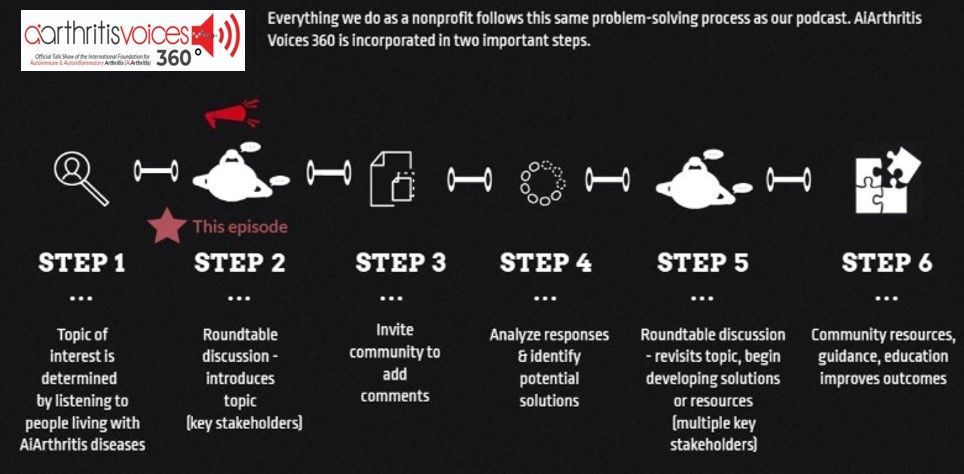
All our main 1st Sunday of the month episodes are either an initial "put the topic on the table" episode (Step 2 in our organization's 6-step problem solving process) or a "revisit to the table" episode (Step 6 in our organization's 6-step process), where we build on a past show because we have moved forward in developing help, tools, or projects around the issue (Step 5 in our organization's 6-step process).
After each show airs we spin off the conversation into many discussions over various formats, which we now call #360its.



-
Additional Resources & Information
Go With Us! To ACR 2025: Oral Health
See more about co-existing conditions, disease management and more: Patient Journey
Your Co-Hosts: Who is at the Table this Episode?
Leila P. L.Valete
Leila is the Health Education Manager at the International Foundation for AiArthritis. She is a person living with Lupus and Sjögren’s disease. She is passionate about inclusion and diversity in health education and meeting individuals where they are at in order to learn in a way that resonates with them.
Connect with Leila:
Tiktok: @Lupuslifestyle.lei

Bridget Dandaraw-Seritt
Bridget Dandaraw-Seritt founded a patient based organization that advocates for access to
compassionate care and provides community support. She’s a published author on therapeutic
cannabis, presents at medical conferences, and is engaged in the policy making process.
Connect with Bridget:
Facebook: Advocates for Compassionate Therapy Now
Pull up your seat at the table
Now it's YOUR TURN to join the conversation!

What do you think about this episode?
We want to know what you think! By continuing the conversation with your opinions and perspectives - we all get a better understanding of the problems facing our community. Better yet, through these conversations we can start working and developing solutions.
We mean it when say 360. Not only do we want your input anytime and anywhere, but we also are eager to see where the conversation will take us. So please, "pull up a seat at the table" and let's start talking!
Email us at podcast@aiarthritis.org, message us on social media (find us by searching for @IFAiArthritis)
Relevant Episodes & Projects

Ep. 18 The Juggling Act: Living with Multiple Conditions
Info here about puppies being awesome

Ep 115: CBD and Cannabis in 2025: Where are We Now?
As more treatment options are moving towards Biosimilars, many questions are being raised by patients. What are Biosimilars? Are they safe and effective? Are there downsides? Upsides? What are doctors' opinions on Biosimilars? What should I do if I am switched to a Biosimilar?

Ep. 108: It's More Than in Your Head-- Neurological Manifestations of Sjögren's and Lupus with Dr. Julius Birnbaum
Do biomarkers hold the key to understanding disease severity and predicting disease onset? Tiffany and Patrice discuss the importance of biomarkers & their uses for disease treatment.

Ep. 101 "Go With Us!" to EULAR 2024
Join TIffany and Rick as they address the challenges involved as Treat 2 Target has emerged from aggressive treatments for a larger population to treating per the individual and based on the complexity of each disease.
Love the show? Help us make sure we stay on the air by making a donation.
Your contribution helps us continue the work we do every day to improve the lives of millions worldwide.