


Ep 125: When Pain Becomes Your Normal: Pain Isn’t Just One Thing
AiArthritis Voices 360 Main, Full Episode 125
Air Date: September 6th 2026
This episode is a step 2, as outlined in our 6 Step Patient-Led Problem Solving Process.
Chronic pain can become such a regular part of life with an AiArthritis disease that it changes your understanding of what "normal" feels like. But pain isn't always tied to active inflammation or a disease flare, and even one person can experience many different types of pain.
In recognition of Pain Awareness Month, host Leila is joined by patient advocates Deb and Kerry for a candid conversation about what living with chronic pain really looks like. Drawing from their own experiences and lived experience data from the AiArthritis community, they explore the many factors that can influence pain, including fatigue, activity, joint damage, sleep, stress, and more. They also discuss how learning to recognize and describe different types of pain can help patients better communicate what they're experiencing with their healthcare team.
From navigating changing pain levels to the trial and error of finding relief, this episode explores the realities of chronic pain that a number on a pain scale can't always capture.
Episode Highlights:
- Why chronic pain can change a person's perception of what "normal" pain feels like
- How pain can persist even when an AiArthritis disease appears well controlled
- What lived experience data reveals about the factors patients say influence their pain
- Why understanding the location, sensation, and patterns of pain can improve conversations with healthcare providers
- The challenges of balancing helpful movement with overexertion and recognizing when your limits have changed
- What years of trial and error can teach patients about managing chronic pain
- Why lived experiences are helping shape future AiArthritis Voices 360 conversations and resources
Links & Resources
- Community Feedback Form - https://bit.ly/AiArthritisVoices360Response
Have questions about this episode or topics you want to hear us bring to the table? Email us at podcast@aiarthritis.org
Donate to Support the Show: www.aiarthritis.org/donate
Sign up for our Monthly AiArthritis Voices 360 Talk Show newsletter! HERE
AiArthritis Voices 360 is produced by the International Foundation for
Autoimmune
and
Autoinflammatory
Arthritis. Visit us on the web at
www.aiarthritis.org/talkshow. Find us on Twitter, Instagram, TikTok, or Facebook (@IFAiArthritis) or email us (podcast@aiarthritis.org). Be sure to check out our top-rated show on
Feedspot!
Follow AiArthritis on all social media platforms

Who is at the table?
Leila P.L. Valete, AiArthritis Health Education Manager & Person Living with Lupus & Sjogren's
Kery Wong, Sarcoidosis, Fibromyalgia, Small Fiber Neuropathy, Rheumatoid Arthritis, and Sjögren's Disease patient advocate
Deb Constien, medically retired Registered Dietitian and a Representative for AiArthritis with Rheumatoid Arthritis
-
Expand to View the Podcast Transcript
AiA Podcast 125 (1)
===
Speaker: [00:00:00] Welcome to AiArthritis Voices 360, the podcast solving today's most pressing issues in the AiArthritis community. We invite you all to the table, where together we face the daily challenges of autoimmune and autoinflammatory arthritis. Join our fellow patient co-hosts as they lead discussions in the patient community, as well as consult with stakeholders worldwide to solve the problems that matter most.
Whether you are a loved one, a professional working in the field, or a person diagnosed with an AiArthritis disease, this podcast is for you. So pull up a chair and take a seat at the table
Speaker 2: Welcome to AiArthritis Voices 360. This is the official talk show for the International Foundation for Autoimmune and Autoinflammatory Arthritis, or AiArthritis for short. My name is Leila, and I [00:01:00] am one of your co-hosts today. I'm a person living with lupus and Sjögren's disease, and I am the health education manager here at AiArthritis.
And I am joined by two amazing co-hosts, advocates, and longtime volunteers of AiArthritis. Deb, would you like to introduce yourself?
Speaker 3: Absolutely. Hi, everybody. I'm Deb Constien. I live in the state of Wisconsin, and I'm happy to be part of this talk show. I ha- I was diagnosed with RA at the age of 13 and basically 43 years of having this disease, so with all the ups and downs that go with it, and newly diagnosed with Sjögren's disease as well, and again, a whole lot of other comorbidities.
Tossing it to you, Kerry.
Speaker 4: Hi, everyone. I'm Kerry Wong. I am in New York. I am a person living with... Let's see. Gee, the list goes. Sarcoidosis, which is a rare inflammatory condition that [00:02:00] can affect kind of anything and everything, but also rheumatoid arthritis, Sjögren's. Like Deb said, a whole bunch of comorbidities.
As my rheumatologist calls it, autoimmune soup is basically kind of where it all comes down to.
Speaker 2: And like I said, both Deb and Kerry have been longtime volunteers here at AiArthritis, been around for so long and have been co-hosts for a long time. And, you know, in the past year or so the t- the talk show has taken a little bit of a back seat, but I'm super excited to say that it is getting out of the back seat, and we are having the talk show be, you know, front and forward and right in front of everybody because it's gonna become an amazing part of our lived experience data process.
And I wanted to, you know, again, reiterate what we are working on when it comes to lived experience data. And you may have heard the past few shows and heard me talk about it, but we wanna make sure that everybody understands what our goal is with these talk shows. And so [00:03:00] everything is gonna be starting with AiArthritis Voices.
And AiArthritis Voices is no longer gonna be a program. It's actually a community of people that come together that want to get involved and you know, have opportunities to help im- not only improve their own patient journey, but the patient journey of others by contributing their own experience. And so they'll pr- contribute,
you know, i- in conversations, surveys, and feedback opportunities even help to review and test tools and resources, help identify unmet needs that we don't see and contribute to projects where lived experience can help influence education, advocacy, research, resources, and other work. So AiArthritis Voices 360 falls into that cycle.
We listen, and then those topics help shape the talk show topics. Before the episode, we dig deeper and ask questions so that we're able to have more lived experience data to talk about during these [00:04:00] episodes. And then after the episodes, we even keep listening through our community feedback form, where you can tell us what resonated with you what your experience has been, if there's anything we didn't cover and you wanna let us know that we need to talk about or any questions that they may have.
And then once we see all the feedback, sometimes we'll even take it 360 degrees, which is the AiArthritis Voices 360 it, which basically means that we may create conversations furthering exploration of that topic or that topic with a specific disease or anything that might be related. And so that's basically what we're gonna be doing today.
And this is the first episode that I have other co-hosts that haven't been a part of the process. And so, I'm super excited to, you know, jump in here. We're planning on inviting, you know, a, a good amount of new co-hosts as well to be able to be a part of this process. So you can look for that [00:05:00] coming at the latest in the beginning of the year.
So that's gonna be very fun And today's topic, we're going to be talking about pain. Chronic pain, something that a lot of people talk about and a lot of people experience. And September is Pain Awareness Month. And so we want to make sure that people that don't live with chronic illness, don't live with autoimmune, autoinflammatory arthritis, can get a little glimpse into what it's like to live with chronic pain, and specifically the chronic pain that we live with, that it's, you know, it, it's triggered by certain things that might happen in your life and not necessarily the mechanical pain or wear and tear pain that people can have from osteoarthritis.
Even though I'm sure that me, you, Kerry, we all probably also still have osteoarthritis as well. So, there's that kind of pain that we deal with too. So during this Pain Awareness Month, we're starting with something that came through loud from the community, and [00:06:00] that is that pain is complicated. And even two years ago at EULAR, Deb and I dove deep into the different types of pain that came about and that people are starting to talk about re- you know, noci- nociplastic pain and all of these different places that pain can come from, from your nervous system.
You know, there's lots of different types of pain that people experience, and it's all lumped into, like, one- Category ... category. Yeah. And, and I think that's what makes it really hard sometimes to manage. So we'll, we'll dive a little bit deeper into that. And so starting with our Go With Us survey one of the questions we asked was, "When you think about your pain, do you feel it is always connected to disease flares and inflammation?"
And the answers were not all the same. There were seven respondents. Three out of seven said yes to almost always, two said that their pain often occurs even when their disease seems controlled, one wasn't sure, and [00:07:00] one described their pain experience as, "It's all the time, just at different ratings."
And isn't that the truth?
Speaker 3: My goodness. You couldn't, like- So much ... sum it up more. And again, to actually, like, what day are we talking about? I could be a one or a six, you know? I mean, just all the different things that go with that. And I love how intentional AiArthritis is being with breaking things down and involving the community some more.
You did a great job explaining everything that
is kind of changing about the podcast, and I think that's fabulous I love it.
Speaker 2: Yeah, and I think one of the things that I, I wanna start with that we can talk about is one thing that I like to say to explain to people about chronic pain is that I feel like on an everyday basis, my pain that I live with is like a three or a four on a regular person's scale, [00:08:00] if that makes sense.
On a- Yeah ... on a non-chronic pain person scale, I feel like I am at a constant three or a four, but to me, that feels like a zero. So that's- Great ... I think that is the way that I like to explain it. And that also means that, you know, a lot of the time for me, things that might be a 10 to people more feel like a seven to me or things like that because I'm just so used to being in pain.
And I know that we've all had pretty significant relationships with pain throughout our whole lives, and our experiences aren't identical, but we've talked a lot about our experiences with having pain at, in early childhood with both me and Deb, migraines and headaches being a really big one, you know, kind of, you know, crossing over into that neurological side and GI, gynecological pain, muscle and joint pain, injuries that happen and that cause even more pain for you than than the normal.
So there's a lot of different [00:09:00] long-term joint damage and even fibromyalgia that causes pain as well and is a common comorbidity for AiArthritis. And so Kerry, I know that when we were talk- It's really above. Right? When we were talking before, I know that you talked about explaining, like there's, there's ran- random achy pains, and that is so true.
Like I I will wake up sometimes just like, "Okay, my elbow is hurting for what reason?" And so I, I know that you wanted to talk a little bit about that.
Speaker 4: So I think, you know, i- it was younger. That's what I used... That's kind of how I used to refer to it, is I just ha- I mean, there were GI issues and pains from, with that, but at least, you know, it's in my stomach.
I know it's a GI thing, or it's in my head. I know it's a headache, although lots of variety in that. But at least those kind of had a place. But then I had these other, like, I used to just call them random achy pains 'cause they didn't make sense. It was just all of a sudden my elbow hurt, and then it didn't, and [00:10:00] then my knee hurt, and then it didn't.
And then, you know, sometimes it was worse and sometimes it was nonexistent, and it wasn't like that I had just done something to make it hurt. It just didn't make any sense. And, you know, so years later now at least I understand that those pains were related to, you know, all of these other, you know, conditions that I have since been diagnosed with,
since come to, you know, to realize and, and ha- You know, so it's, it's validating at least having that understanding of, "Okay, so now I know rheumatoid arthritis affects everything," you know?
It can affect all these different joints. Inflammation can affect all these different joints. Fibromyalgia can affect all of these different areas. And so the fact that, you know, anything autoimmune, it can kind of, you know, fluctuate here and there. And so knowing that much at least, there's, like, validation in that.
You know, I don't feel like I'm going [00:11:00] crazy. Like, what is going on? At least I have an idea of what's going on, and that's something that was missing for years y- when I was younger
Speaker 2: Yeah, I totally feel that, and I think that that's huge to be able to, to distinguish the differences is, is hard, but it, it also makes it maybe a little bit better to help explain to your loved ones, like, what's going on with you at that moment instead of saying, like, "I'm just in pain."
"Well, you're always in pain. Can you give me more of a description?" I'm like, "Okay, yeah, you're right." I go from complaining to describing I think is the, is the difference. But I wanna complain first, you know? And Deb, so I know that obviously you've lived with RA for a really long time, and there, it's done a, it's done a number on a lot of your joints and it's caused a lot of pain.
Was there a time that you realized that pain was gonna be kind of like a forever thing and that it, it wasn't temporary and, and how that kinda changed how you [00:12:00] saw your RA and, and, and how you were going to live your life in, in the future?
Speaker 3: No yeah, 'cause I was a freshman in high school when, you know, I had a surgery, and that was kind of the trigger that kind of brought on my disease in full big whammy, and had to stop...
You know, I guess if there was a depressed time, it was learning how to give up being on the swim team, not being able to play my flute anymore. It, it was just some realization, and it was I, I don't think I really understood the pain throughout high school because my parents were trying to protect me and they weren't giving me the full picture of what was going on, which I don't recommend that at all.
A- and I, I feel like you try to explain to a child in the best way [00:13:00] you can as much as they can handle, you know, as far... But full disclosure, you know, I think is incredibly important 'cause it left me very frustrated and angry just not knowing. And my personality, and even now, I wanna know everything. I wanna know worst-case scenario.
I wanna know everything. And not everybody's like that, though. So, again, you've gotta meet people where they are and, you know, the acceptance. But I think it started to, like, sink in that this was going to be hanging around. 'Cause I also was initially told back in the day, after 13, that you have JRA, juvenile rheumatoid arthritis, which is now called JIA, and they basically said you could grow out of it.
So that left some hope for me early on. And I think it was probably college and starting to see the [00:14:00] destruction that started really showing up, 'cause I wasn't on great medications at that time it really started to become more clear. And even when I met my husband, just people's perspective of what that's gonna be my mother-in-law basically said, "Do you know what you're gonna get yourself into?"
to my husband before we got married, and he re- Same ... yep, he relayed that to me. And it's tough, you know, as far as that goes. And to feel that on your shoulders as well as being in pain, that was a lot. So that mentally kind of just kind of takes you down a few pegs. But I think over the years I've learned how to describe my pain better.
Like we earlier on were just... Like Leila, you were describing is it burning? Is it throbbing? Is it radiating? I've learned really good words to describe 'cause it is different. Every pain is different, and those words are [00:15:00] very valuable to the doctors in interpreting what's going on and, like, what direction to look at It's been a learning curve.
Speaker 2: Absolutely, and we talk about the pain scale, and there's a lot of different ones that are out there. You know, for the kids there's the smiley faces, and even for the adults sometimes they'll use the smiley faces because I think a lot of people don't resonate with the, with the number scale. I feel like it's really hard to...
'Cause it's very subjective. Like I was saying before, like, w- for, you know, for someone who, say like for us, getting our blood drawn, that is probably a zero or a one.
Speaker 3: Piece of cake. B-
Speaker 2: before my husband, it
Speaker 4: is- And I did it twice yesterday.
Speaker 2: For my husband it's a whole affair that he has to, you know, calm himself down.
Trauma. Trauma. Don't look. Yes. And again, I don't, you know, it's- And I'm not laughing at them ... you being afraid of needles. Yeah,
Speaker 3: I'm not laughing at them. I, I- I, I [00:16:00] get it.
Speaker 2: Yes. But like we said, it's very subjective, and so I think there needs to be some more of, you know, accurate ways for us to be able to depict that or be different levels of, of the pain scale for someone who's living with chronic pain versus not, or something like that, to kind of help everybody understand a little bit better.
Speaker 4: Yeah. Definitely. I think, you know, it's funny, I hate the 1 to 10 pain scale so much. You know, and I feel like, Deb, like you said, you know, when they ask you, "Where are you on a scale of 1 to 10?" It's like, well, which body part are you talking about? And do you mean right now? Do you want an average? You know, there's so many things, and it's so subjective, and it changes so much.
And, you know, I know there's Karen Duffy, who also lives with sarcoidosis, she wrote a book called Backbone. She actually wrote a few books, and in one of them she talks about a Bill Murray pain scale, and she has like different faces of his that show things. But I think the best that I've ever seen I saw it on social media years ago, and I've, it's come up a few [00:17:00] times.
There's a pain scale in terms of artwork, and so it shows these like, you know, great famous paintings, and it's like where do you range? And there's a Mona Lisa, and it's like, well, I can just grin and bear it. Or there's a Picasso, and like there's something really wrong here. Or a Scream, and it's just obviously you're ready to scream.
And, you know, so it's, I feel like that just, you know, they say a picture tells, says a thousand words, and, you know, I mean, it's a lot more than any numbers. And I feel like something like that, the pain, the, we definitely need something that, you know, just is a lot more expressive and emotive and variable and understanding and-
Speaker 3: Relatable
Speaker 4: numbers just don't cut it- Relatable ... on their own. For
Speaker 3: sure.
Speaker 4: Yeah.
Speaker 2: You know when you, oh yeah, when you showed that to us, I was like, "Oh yeah, the scream one. I, that one has to be on there."
Speaker 3: It was really good. I'd never seen that scale before. And again, I can put myself in every single one [00:18:00] of those photos at different times, you know?
And it just depends. And, you know, even in one day you can go from a two to a 10, and that's not unusual for sure.
Speaker 2: Just in terms of, like, describing, just an exercise of describing, what level of pain do you think you would have to be in in order to call it a day and say that you need to just rest the rest of the day?
Speaker 4: Eight.
Speaker 3: I'd be an eight
Speaker 4: See, it's funny. I think I used to say I could function up to an eight and nobody would even know, 'cause I can just mask it that well and keep on going. And I used to be proud of that, but I think that I've... My perspective on that has changed r- more recently, and I feel like, you know what?
That's not necessarily something that we should have to do. I don't [00:19:00] want to have to, and I shouldn't have to push myself to the point of absolute utter misery just so that I can say, "Look, I still did it." Like, we're, we're in pain, we're sick, we're suffering, we're, we're allowed to kind of relax a little bit and not always be completely miserable.
So now I've, I've... You know, I mean, it's, it's situational, but I've gotten to the point where I'm a lot more forgiving of myself, and I'll give myself grace, and I don't have to push myself past that eight or nine before I'll stop. It could be a five or a six. And, you know, just as an example, I was supposed to go to a concert last week.
So bummed to miss it. But I was really not feeling well. I was hurting. And like, yes, I could force myself to go, but then I'm gonna be sitting at the arena, it... Well, I'm gonna be sitting in the car miserable, hurting, trying to, like, shift and move to try and find a position [00:20:00] that's not as painful. I'm gonna get the con- to the concert, and instead of screaming Bryan Adams out, you know, as loud as I possibly can, I'm gonna be, like, squeezing my husband as hard as I can 'cause it hurts.
And I just de- like, I'm not gonna enjoy that. And so I've very, very recently gotten to a point where I am not pushing myself to that absolute beyond miserable pain and, and I'm taking a break earlier and, and con- trying to convince myself that it's okay to kind of take a break when I need to. You know, when, either when it gets that bad or before it gets that bad, or sometimes so that it doesn't get that bad.
Speaker 3: Yeah, it definitely resonates, 'cause I'm thinking you have to learn how to do that And I, I know all of you that are listening to this podcast can't see us, but we can see each other. And throughout
this whole thing, we're all nodding. So again- Which- ... we can't [00:21:00] vocalize every time we're nodding, but, like, we're nodding to each other the whole time.
Or if
Speaker 2: you wanna see us, you can watch on YouTube. You can- Oh ... you can watch us on YouTube.
Speaker 3: Okay. There you go. And
Speaker 4: you're on on YouTube. Yeah.
Speaker 3: Yes. But I, I agree with that, and actually what I've learned to start doing is protect. So I protect and think ahead if I've got something coming up. So I have a wedding coming up on Saturday night.
So I was busy all day today, but, like, tomorrow and before the wedding, I am protecting and I am going to be just doing very little, and I know Sunday I will be recovering because there will be, you know, whether there's chairs, you know, I'm thinking through everything as far as all that goes. And you just learn to protect.
If you go on a trip, you're protecting before the trip and after the trip. You're like, you know, clear the calendar for at least a week 'cause I'll be recovering from that. That's [00:22:00] one thing I definitely have learned how to do over the years, but I agree with you, Kerry, 'cause, you know, it, it's, it's a journey and it's something you have to learn how to do.
And again, there's things that my husband looks at me and says, "Should you be doing that?" Well, the answer is no, but I'm going to anyways. As we all know, you know. But again, I've got a spouse that at least asks the question but doesn't push it, because he knows not to do things for me without asking and all of those things.
Because, again, we're tough ladies and we, we ... And that, I think, is great. It, this disease has made me who I am at this point, and I wouldn't change that even though it sucks to have this, but I love the people I'm around and you know, advocate with and, you know, learn and teach with. So Cool.
Speaker 2: Yeah, the hyperindependence [00:23:00] lives, lives strong with us here.
Ooh,
Speaker 3: indeed.
Speaker 2: We have, we have to fight it a lot. Yeah. And I think I think one thing is also with me becoming a mom shout out to all the moms out there because I never thought about how many things that you have to do in one day. I never knew how much there was to do in a day, and I think i- I have a, you know, a much more appreciation for what it takes to be a mom and to have someone relying on you all day every day.
I think that that has ... Even though I haven't been practicing it as much, you know, being seven months postpartum, it's been hard, but I do believe that, you know, I do have to take care of myself in order to be able to take care of him, and I think that's the biggest thing is there's even more motivation now to make sure that, you know, I do take care of myself so that I have enough to be able to take care of him and enjoy enjoy him, you know?
Yeah. I think that's the biggest thing, so ... But I would say, too, that I would probably say that it would be an eight as well. Like, I ... In order to [00:24:00] get me to not do anything, I'd have to be in, in, in a lot of pain. But I do- That's
Speaker 3: our scale. That is our scale of pain, not a regular person. Yes. And again, we're talking we're talking apples to oranges, so it's very different.
And again, we're tough ladies. But I agree
Speaker 2: with you. Yes, absolutely. The section, the next section here we kind of already talked about and touched on a little bit, but I just wanna reiterate some key words that you can think about using when you're explaining your pain. Because not only is it helpful, like I said before, for your loved ones, it's also so helpful for explaining to your doctors.
Again, doctors work off of data. They work off of what you tell them, but in ... It also depends on how you're telling it to them as well, and I think that that's something, a hard lesson that a lot of us have to learn as we go through, dozens of doctors . But it really is important to help be able to explain the pain to them so that they [00:25:00] can actually help you with whatever is causing that pain, and these words, these descriptors can help with that.
So of course, where does it hurt? Is it aching, burning, stabbing, throbbing? Is it pressure? Is there tenderness? Is it constant or is it intermittent? Does movement make it better or make it worse? Is my nor- is this my normal pain or is it something different? Does it seem like it's connected to inflammation?
Like, do you know that other stuff with your disease is going on? Have you had high labs during that time? Things like that. And what else was happening when the pain started or when it changed? So asking yourself those questions and thinking about that when you're trying to describe your pain can be really helpful because yes, we all, we all are hurting at almost every moment of the day.
But explaining that one pain that you're concerned about is what's important to be able to help get the right help
Speaker 4: [00:26:00] Yeah, I wrote I wrote a column I think maybe a year or two ago. I, I write a col- sorry, I forgot to mention this earlier. I write a column for Sarcoidosis News where basically I'm kind of sharing various aspects of life, but through the lens of somebody living with chronic illness sarcoidosis and the other things that I'm dealing with.
And, you know, I wrote something that was specifically about kind of recognizing the difference between, say and, and describing, explaining, and understanding the difference between, say, for instance, an acute pain, which is something that, you know, just kinda comes on. Usually there is a specific reason this happened, that's why this hurts, and this is how you deal with it, versus chronic pain and, you know, the different types.
And, you know, e- like Leila was saying, you know, the ways that we can describe it, the shooting, the stabbing, the, you know, the, whether it, it, you know, things that I've said you know, when it feels like your my head is in a vice, or it feels like this joint is about to burst, or it feels like, you know, my back is, you know, and when [00:27:00] you feel something in a complete spasm.
And I think sometimes, you know, being able to tell the pins and needles versus the shooting versus the ache versus the soreness versus the sharpness and all of those different types of words that we can describe and where it hurts. Each of those things, they can help, You know, if I say my knee hurts, that could be a lot of things.
But if I say that it's, you know, a, a shooting pain that starts in my lower back and goes, you know, and shoots down my leg, chances are they're gonna understand that's likely a nerve pain. If I say that it's, you know, this pain here that's like soreness, well, there are muscles here. And so it gets kind of a better sense of what's going on, and that helps the doctors to kind of figure things out a little bit more.
It also, I think, helps the other people around us to get a better sense. So like Leila said, it's not just like, "Yeah, well, you always hurt." Okay, but A, yes, I do, and B, but here's what's happening [00:28:00]
Speaker 2: Absolutely. And I wanted to transition a little bit into pain management and different interventions that we've all tried before, and things that have worked, things that have...
that haven't worked. Obviously we are not necessarily medically rem- recommending any of these. We're just talking about our own experiences and you know, what worked for us and, and what doesn't work for us. And, you know, for me it's really been CBD and THC that has helped me a lot with my joint pain.
I, I have a lot of hand pain when I'm waiting for my next infusion. Like the week before my infusion, my hands start to hurt a lot, and that's how you... I can tell that I'm due for my infusion. I've, I've also done chiropractor. That helped a lot when I had a lot of chronic hip pain. But I know that you guys have had a little bit more experience when it comes to, like, actual pain management clinics and, you know, other pain medication that might have helped.
Anything [00:29:00] about your journey in particular that stands out to you when it comes to pain management and the treatment of pain that you wanna tell the audience?
Speaker 3: As far as I go something that has helped me is massage therapy because I carry a lot of my stress and when I am in pain, things tighten up more, and I carry it in my neck and shoulders.
So actually having somebody work on the muscles in my neck and shoulder really helps just tries to loosen me up a bit. So that has been helpful in the pain journey. Back in the day, I was put on a fentanyl patch, so it's something that, again, is highly questionable through a lot of doctors and again, I've been on it for probably over 20 years, and it's no joke trying to get that and not feel like a drug seeker and all of those things.
[00:30:00] There's a lot of judgment that goes with having that. But it, it really has helped me lead a life that I can still participate in. If, if I could go back, I'm not sure I would have accepted going on it, but I think I was really desperate during that time, and th- they were throwing their hands up on trying to keep my pain under control.
So I guess I was, you know, between a rock and a hard place and accepted it at that point. If I could go back, I don't know if I would have 'cause it has caused... Just getting it through the pharmacy and having to go through the drug testing through the doctor's office because they have to have proof that you're doing and not exceeding the amount of medication that you're given and all those things.
It, it does kind of mess with your head a bit, but it has definitely [00:31:00] Helps me lead a better life because when I put... You apply it every three days, and I'm on a really low dose, which
is 25 micrograms, and it goes way higher. So I'm glad that I'm on a low dose, but I definitely can tell when it's time for my, to change my pain patch, so, again, every three days.
So it's, it's interesting. You know, I look at what I go through, and there are a lot of hoops you have to go through, and you definitely feel judged, and, you know, the pharmacist even giving it to you, and if I'm going out of the country, I have to get special dispensation to get it early, and there's a lot that goes with it.
So I, I don't love all of those things, but it definitely has helped me throughout the years. And again, if [00:32:00] I could go back, I might take it back, but I don't know if I'd be living the same life I am, which is interesting to think about
Speaker 2: Yeah, definitely give yourself grace though, Deb. I know that, you know, your RA is different than a lot of people who are d- diagnosed with RA now in the- Yes
past 10 years. You know, your, your body has gone through a lot of, you know, change because of the RA and, you know, the, you know, different things that happen to your joints that don't, don't really happen to people who are diagnosed nowadays, thank goodness, right? Because of all the, you know, advanced medicine.
Speaker 4: Yes.
Speaker 2: So you know, if you need a little bit of help to get through the day because your joints are all messed up from the past how many years that they've been- Exactly. Exactly ... that they've been going at it- Yeah ... then it is what it is, and that's what it's made for. Yeah. And screw all those people that judge you.
Speaker 3: Yeah, ex- I, I, I do get to that point 'cause I, I'm like, "Come on, people." At least, I mean, yes, there's a lot of judgment around fentanyl especially and everything that goes- Yeah ... with it, and so [00:33:00] many bad intentions that happen with fentanyl. So like, I feel like I kinda get lumped in that category a little bit, but, It
Speaker 4: sucks
Speaker 3: it does. But again, I'm still fixing what the first 20 years of, like, inappropriate medication, like, caused. So I, I've had two cervical neck fusions, a wrist fusion, a knee replacement, both feet reconstructive surgeries and I'm probably leaving some things out because, again, all the things and procedures and what happens with your spine.
I've had epidurals and all the other things that they do to try to help the pain in your spine and your neck and all those things. So yeah, I kind of just kinda scoff at times and, but I also, it makes me not wanna go to the emergency room because I was judged for my pain control when I had- Yep ... my knee replacement and suffered [00:34:00] greatly because the nurse thought I had enough, and I wasn't like the other patients, so.
It is what it is, right? We all live and learn
Speaker 4: That, yeah, it's, it's so frustrating and it's so awful how much we get judged for, and how much things like bureaucracy and red tape and logistics get in the way of what would simply just help us. I actually... It's, it's funny. I was on a fentanyl patch very briefly.
The, the, the reason I stopped it, the main reason I stopped it w- well, partly it wasn't helping me, but also I, my skin I get really bad reactions to any kind of adhesive Yeah And so I had a couple different patches that were just- I can only have- ... very bad for
Speaker 3: my skin ... one brand. I can only have one brand So again, adhesives as well.
Speaker 4: Mm-hmm. But what's funny is I was not judged, ironically, I was not judged for the [00:35:00] fentanyl. And in fact, the fact that I had used fentanyl and it was not enough to ease my pain, after seeing what it has done and, you know, how many people have, you know, died from it and things like that-
Speaker: Right ...
Speaker 4: that's one of the things that made people finally understand, like, wow, my pain really is severe and I'm really struggling with it if it's so bad that even that wasn't enough.
Some of the things that have helped me the most non-drug related actually I love, absolutely love acupuncture. It is amazing. It is... The last thing in the world that you would think is that it is really relaxing somehow. Like, laying on a table even with, like, dozens of needles stuck in you, it just somehow it's relaxing and it helps.
Unfortunately, it is not covered by insurance, and it is not quite inexpensive. So it, Not
Speaker 2: at all I've actually been wanting to try 'cause it, it's actually covered through my insurance.
Speaker 4: Oh. Oh, I highly... If you are [00:36:00] able to try it- I would do it ... I... We give no official medical recommendations- Yes, yes.
Agreed ... but-
Speaker 3: Agreed ...
Speaker 4: Leila, as your friend, I would say it's definitely worth giving it a try. I love acupuncture Been on the list. I need to. I... Massage I've had mixed results. Sometimes it feels really good. Sometimes because of the fibromyalgia it just- It is swell ... any touch is just way too painful.
Cannabis, whether in, you know, back in the day it was just, you know, CBD. I've had, like, CBD creams and things like that that were really, really helpful in, you know, for a specific ac- you know, one direct location. Say my knee hurts, I put a CBD cream on it, it was really helpful. Didn't help with all the other things, but it was one thing.
I'll take it. I've had, when it became legal in New York, I got a medicinal marijuana card, and I started using it then. Ironically, I had never tried it before. [00:37:00] You know, 40-some years of growing up in New York, I never once tried pot. But once my pain management doctor actually recommended it because the trigger point injections that he was doing, the nerve blocks that we had done were not helping me.
And so he said, "Have you ever tried?" And he recommended and referred me to somebody who was certified to, to do medical cannabis. And that has been helpful not completely, but it kind of takes the edge off. And I've kind of learned a, a, a decent amount about, like, the different, you know, benefits of, say, the CBD part versus the THC part, and some better for inflammation, some better for neuropathy, that kind of thing.
And so that has been helpful, but again, not covered by insurance and not inexpensive. Also something that you cannot take across state lines. And so if I go as far as a game in New Jersey, I can't take it [00:38:00] with me, let alone when I go on vacation. And so, other things that I really like, I try to avoid medication.
I feel like I'm on so much medication already that I don't want to take more. Plus, there's so many things that just I feel like been there, done it, didn't help. Okay, on to the next. But I've... One of, you know, some of the things that I have also really enjoyed is a TENS machine, which is transcutaneous electrical nerve stimulation, and it's basically, like, you put a couple of pads on that are, like, a ch- electrode pads that are, you know, have a wire to a machine.
And it goes kind of like a buzzy sort of feeling, and it, like, activates or stimulates the nerves. And that I find really, really helpful in the moment. When I'm feeling a pain, it can help kind of make that pain go away. It's not a long-term fix, but it's an in-the-moment really good thing. And that's one that I can get more easily and, you know, not have to worry.
I've had a lot more [00:39:00] judgment. You know, I was saying funny that, you know, you had all the judgment from the fentanyl. I didn't have it from that or, you know, when I was on different, you know, opioids and things like that. But I've gotten so much from using marijuana for pain that people just act like it's a joke.
People, you know, "Oh, can I get some too?" And it's like, you're It's not, it's not just a, you know, a, a toy to me. It's not just for fun. This is medication for a medical condition that I, you know, a symptom that I'm struggling with.
Speaker 3: Okay.
Speaker 4: And so when people make jokes about it, it makes it feel like it's belittling me and my experience, and I don't think that they get that.
You know, so there's that. And with things like acupuncture, I've had doctors who have dismissed me and the idea of me and my experience and my pain because, you know, the, the [00:40:00] battle between traditional medicine and more modern or, you know, Eastern- Western, yeah ... Western alternatives and all of that.
You know, that there was a period where, you know, my acupuncturist got mad when I said I was dealing with something medically, and my doctors got mad when I said I was going for acupuncture. And it's like they... For me, what works best is a combination of things. You know, we've all gotta find what works best for us, and yeah, people really need to just stop judging and, you know, give us some grace.
We're dealing with a lot and, you know, let us find what works.
Speaker 2: Yeah, or have whatever ideas that you want in your head, but, you know, keep it to yourself. Yes, agreed.
Speaker 4: There you go.
Speaker 2: 100%.
Speaker 4: Word of concept.
Speaker 2: Yes. I did wanna mention something though that was very surprising to me, was after... So I had a very traumatic birth.
I ended up having a second-degree laceration as well as a botched [00:41:00] episiotomy. So basically, they they cut into my anus. So from, they cut from my vagina through my perineum to the anus, and so I had to deal with wound care for two weeks straight, and I have never had an, that much fentanyl in my whole life because that, they tried to have me go in there not medicated, doing wound care.
Speaker 3: Oh, my gosh.
Speaker 2: Are you insane? Are you actually insane to think that I could deal with the pain of wound care without any medication?
Speaker 3: That's
Speaker 2: beyond- and even, yeah, even just the examination of them
evaluating when it got infected- And touching ... they did, they-
Speaker 3: Touching ...
Speaker 2: yes, they did that, they did that exam without medication, and thank goodness Joseph was there, because I was literally turning away and crying while they were doing it, and he was like, "Say something."
And I was [00:42:00] like, "It's gonna be over with," like, "Just, listen, let it, like, just get it over with." And he's like, "You've, I've never seen you cry like this from a, like, an examination." Oh. Yeah. Like, "Say something." And he f- he finally said something, and he's like, "She's in pain. Can you get her something?" And they, like, instantly went to go get the fentanyl, and it's like, I mean, even more so obviously with chronic pain, but, like, then we talk, touch on, like, the, the gynecological side and how- Yes
painful it all is. Like, you know, even just getting, even just getting the, what's the, speculum inside you- Yes ... is, is painful, you know? It's like even more so, how can you imagine, like, the pain that ha- you know, all of that was? And so-
Speaker 3: I
Speaker 2: had- ... that, I,
Speaker 3: I- I had a colposcopy- Yeah ... where they go in and rip a part of your uterus, and for sample, and they give you nothing.
So they just go in there, and they're like, "There aren't that many nerve endings in there," and I believed them and went in for that, and I [00:43:00] literally was bawling during that procedure. And they're like, "Are you okay?" And I'm like, "Actually, no." I, like-
Speaker 2: Yeah ...
Speaker 3: I mean, I, I don't even know how to describe that kind of pain from within, and y-
Speaker 2: No, yeah
Speaker 3: the, the trauma you will probably have had from that, holy cow
Speaker 2: Man, and I think that there is some kind of connection here. Obviously, people who live with our diseases are mostly women, deal with this pain on an everyday basis. Yeah. Obviously, the people who are giving birth are women, and I, I think that our pain all o- overall is just really dismissed.
And you know, again, you know, back in the ye olden days, women used to get diagnosed with hysteria because they were- Oh, yeah ... in so much pain. Yeah. And all of- Right ... these different things. And it's unfortunate. Another form of judgment. Why don't people just, just believe us when we're in pain, and that we need to do what we need to do to not be in [00:44:00] pain, you know?
Like- Right ... the, the judgment is, is a little bit too much sometimes. And you know, we're just trying to live our lives- 100% ... like everybody else is.
Speaker 3: Agreed, 100%.
Speaker 2: All righty.
Speaker 3: 100%.
Speaker 2: You know, we could, again, we could talk for days about this subject, and we have already. Yeah. But I think one of the biggest things that I just...
I... Just a, just a takeaway, whether it's what you would want the healthcare system to know about chronic pain, or what you would want another patient, you know, to know about living with chronic pain. You could pick one or the other, whatever you guys would wanna say. But just like some you know, kind of takeaway point that you would like to say.
Speaker 3: I think I would just to a healthcare provider of look at our charts. A- again, we're not lying, we're not making it up. I want to be believed, and I want to feel seen. And again, all the mental health things [00:45:00] that go... With the anxiety of going to the emergency room for me is, like I refuse to go until my husband's dragging me, 'cause he's like, "We've passed this point of, like, we- we're not doing this anymore.
We're going." And just being believed is probably... A- and again, I know there are drug seekers out there, and you have to figure out who is and who isn't, but look at our charts. Again, like, I'm not in here every month. I mean, it, it, years go by before I'm in an emergency room or complaining. I mean, for us to complain, that's a lot.
'Cause again, we're not complainers either, and we can see it on each other's faces 'cause we know what that is. But just being believed, I think that is the biggest thing, and look at our charts 'cause I'm not making it up.
Speaker 4: I mean, definitely that. [00:46:00] Also, which just, yes, yes, yes. But I would say to both practitioners and to patients, ask questions.
Because the thing that, you know, i- in thinking about this whole, you know, conversation, you know, one thing that like popped into my head was I remember when I was in high school and I was at the doctor's office, and I was in all kinds of pain and trying to figure out what was going on for a couple of different things, and the doctor said, "Well, you know, stress really does a number on your body."
And like, "Okay. Well, yes." But to me, what that said was, "So just accept it." And that was, you know, like, that should be the start of a conversation, not the end of it, you know? I wish that I knew back then that I should, like, say, "Okay, well, so, like, what does it do and what can I do about it and how do we deal with it?"
Rather than just taking it as just the answer of, "Okay, just get used to the fact that you're always gonna [00:47:00] hurt because, you know, stress." Yes, stress absolutely does have a big effect on things. It aggravates
Speaker 3: You're making me laugh 'cause I'm like, "Oh my gosh, yes." Yeah.
Speaker 4: And, and to those who can't see, to those who can't see, I'm, you know, doing the gestures at everything.
But that's, it's not that simple. And so ask questions about what's going on, you know, to doctors. Ask questions about what kind of pain and what's leading up to it and where and how and why. And to patients, ask questions about what is actually happening and what can we do about it. And if you're not satisfied with the answer, ask again.
And if you're still not satisfied with the answer, ask somebody else Because you deserve the answers.
Speaker 3: You don't have to stick with the same rheumatologist. You can fire them, and you can move on.
Speaker 4: Yes. Yes.
Speaker 2: Yes. Yes. Any, any doctor, [00:48:00] any practitioner. And just, yeah, I think the, I think even to this day, living with these diseases for so long, I still get intimidated being in the ER, being in the doctor's office, wanting to, to not make, you know, make a big deal, not to cause a ruckus, and I think even also since becoming a mom, I've, I've just, like, not given a dang about anything anymore besides what's important, my family, myself, my health, and all of those things.
And I, I wish that upon everybody, that you can just care about what the point of the doctor's appointment is and not care about what anybody else has to think about it, 'cause that's gonna be your worst enemy, is feeling like you have to mute yourself, silence yourself, quiet yourself when all you really need is help at that point.
So I think that is a, a really big lesson that a lot of people who live with our diseases has to learn, and everybody learns it at a different stage of their journey. [00:49:00] But what I hope is for everybody who's in the beginning of their journey, still waiting to get diagnosed, that you learn it at that point so that you can take it with you throughout your whole journey because it's needed.
You need to, you need to advocate for yourself and not care about what anybody else thinks.
Speaker 3: Yeah, and when I've been my sickest, I've had to lean on my husband, and he has learned, 'cause again, being married for 34 years, he has learned how to advocate for me and not take all the BS that can actually be happening.
And he, like, 'cause at that point when I've been my sickest, I don't have fight in me, and my fight is gone. My giving two crumbs about anything are gone. It's just, "Somebody just help me," and that's when he takes over, so thank goodness for that. And I feel for people that don't have a significant other, [00:50:00] and maybe it's time to lean on a friend to go with you because there are people.
And if you're a faith-based person, find somebody from your church to bring with you as an advocate because sometimes when you're in that much pain, your fight's gone Like Joseph needed to step- Yeah, even if it's someone- Yeah, he needed to step up for you ...
Speaker 2: yes. Even if it's someone on FaceTime- Yes ... or something like that, having someone else in the room really does empower you and helps you to make sure that you're getting your point across, and that, and that person can help you as well.
But I think that's a really good piece of advice for those who... Especially, like you said, when you're in pain, it's really hard to know even what's left from right sometimes. So, having someone else there can be really helpful. And like we said in the beginning, pain is complicated, and I think we've demonstrated that in our conversation here today.
Our own experiences and what we're hearing through our lived experience data work [00:51:00] shows that pain can involve inflammation, but people's experiences can also be affected by joint damage, activity, fatigue, sleep, stress, weather, nerve symptoms, other health conditions, and many other factors. And one person can also experience many different kinds of pain at the same time.
So learning to recognize your pain and your patterns, and finding ways to describe what you're experiencing may help you communicate more effectively with your healthcare team. But, you know, the conversation is never finished. Again, with this episode, we started by sharing some information from... that we got from members of our community through a survey.
And if you have anything else to say, anything to contribute to what we said today, there is a community feedback form that will be in the description, in the show notes of wherever you are listening to
this podcast. Please let us know what resonated with you. What does chronic pain look like in your life?
What did we miss? What [00:52:00] questions do you still have? And what part of pain do you think still needs a little bit more of a deeper conversation? Your experience can help us understand what's happening in our community. What we learn can shape the conversations we have and questions we ask next, and help build our resources and projects that we all build together.
And at AiArthritis, we don't just represent the patient voice, we are the patient voice, and with your support, we can help amplify it even further. If you found value in this talk show, please consider making a donation to help us continue producing impactful conversations, bringing all stakeholders to the table to discuss patient-identified issues and patient-infused solutions.
You can visit aiarthritis.org/donate and help us make a difference together. Thank you again for tuning into this episode of AiArthritis Voices 360. Please Kerry, let us know where they can find you on social media.
Speaker 4: Sure. You can find me on BlueSky or [00:53:00] LinkedIn or Substack @ButtaflyK. Just I spell it a little bit differently.
Like I said, I'm from New York, so I spell it like I say it. It's @B-U-T-T-A-H-F-L-Y-K for Kerry.
Speaker 2: Thank you. And I'm not sure if you are putting out your social medias public, Deb, but if anybody wanted to find you?
Speaker 3: Yeah. I'm on Facebook, Instagram, TikTok all those different platforms, and it's, Facebook, it's Deb, Deb Major, Deborah, Deb?
I think it's Deb Major Constien, and the middle name is the middle, my maiden name is M-A-J-C-H-E-R, and last name is Constien, C-O-N-S-T-I-E-N. And I go by Deb Const- or Deb Constien together. That's kind of my handle. And yeah, I- anyone wants to ask more questions, and we can bring it back to the table and talk and amplify things more, [00:54:00] reach out to all of us, but AiArthritis especially.
Speaker 2: Absolutely. And you can find me on my personal social medias at lupus.lifestyle.lay on TikTok and Instagram. And you can find AiArthritis on all major social media platforms at I-F AiArthritis. And that's a wrap. We will see you here next month on the next episode of AiArthritis Voices 360. Thank you.
Speaker: AiArthritis Voices 360 is produced by the International Foundation for Autoimmune and Autoinflammatory Arthritis. Find us on the web at www.aiarthritis.org. Also, be sure to subscribe to this podcast and stay up to date on all the latest AiArthritis news and [00:55:00] events.
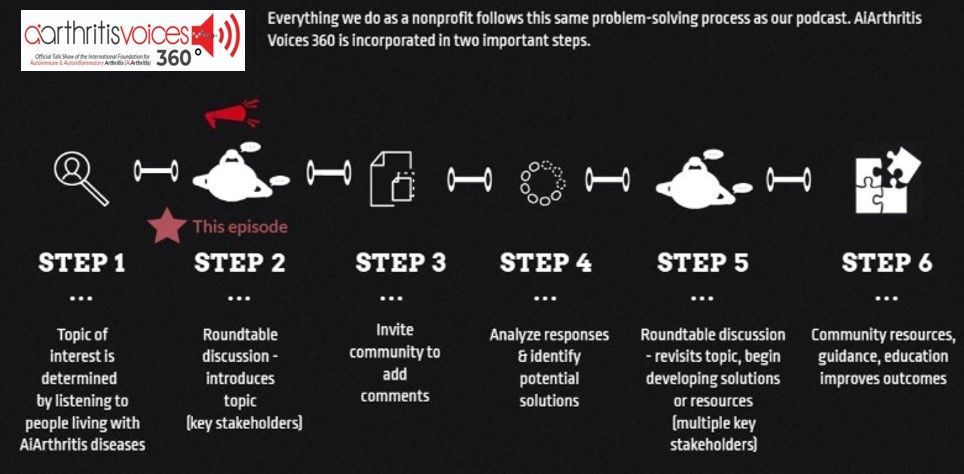
All our main 1st Sunday of the month episodes are either an initial "put the topic on the table" episode (Step 2 in our organization's 6-step problem solving process) or a "revisit to the table" episode (Step 6 in our organization's 6-step process), where we build on a past show because we have moved forward in developing help, tools, or projects around the issue (Step 5 in our organization's 6-step process).
After each show airs we spin off the conversation into many discussions over various formats, which we now call #360its.



Your Co-Hosts: Who is at the Table this Episode?

Leila P.L. Valete, Health Education Manager
Leila P.L. Valete is the Health Education Manager at the International Foundation for AiArthritis. She is a person living with Lupus & Sjögren's. She is passionate about inclusion and diversity in health education and meeting individuals where they are at in order to learn in a way that resonates with them. Leila is on social media as @Lupus.Lifestyle.Lei sharing bits and pieces about her life with lupus and connecting with others.

Kerry Wong
For over a decade, Kerry has been active in the arthritis, sarcoidosis, and rare disease communities, sharing her experience and insight to advocate, educate, and support patients and their loved ones. A self-proclaimed "buttahfly," Kerry recounts her disease-inspired transformations through her Sarcoidosis News column, "Float Like a Buttahfly." She proudly amplifies other patient voices through her book, Kaleidoscope: Rare Disease Stories, and is planning for additional books in the series (next up: Invisible Illness Stories). Kerry volunteers with several organizations and serves on the Bionews Patient Advisory Board. Her goal is to help others in the rare, disabled, and chronic illness
communities feel seen, validated, and empowered.
Connect with Kerry:
Float Like a Buttahfly
Bluesky: @buttahflyk.bsky.social
LinkedIn: @buttahflyk
Substack:
@buttahflyk
Deb Constien
Deb Constien is a medically retired Registered Dietitian and a Representative for AiArthritis with Rheumatoid Arthritis. Deb is also on the Advisory Council for WREN- Wisconsin Research Education Network and a Patient Family Advisor- PFA on an International PCORI research study for ACP- Advanced Care Planning.
Pull up your seat at the table
Now it's YOUR TURN to join the conversation!

What do you think about this episode?
We want to know what you think! By continuing the conversation with your opinions and perspectives - we all get a better understanding of the problems facing our community. Better yet, through these conversations we can start working and developing solutions.
We mean it when say 360. Not only do we want your input anytime and anywhere, but we also are eager to see where the conversation will take us. So please, "pull up a seat at the table" and let's start talking!
Email us at podcast@aiarthritis.org, message us on social media (find us by searching for @IFAiArthritis)
Relevant Episodes & Projects

Mini Ep 16: Unpredictable Disease in a Need-to-Be Predictable Environment
As more treatment options are moving towards Biosimilars, many questions are being raised by patients. What are Biosimilars? Are they safe and effective? Are there downsides? Upsides? What are doctors' opinions on Biosimilars? What should I do if I am switched to a Biosimilar?

Ep. 03: Autoimmune vs. Autoinflammatory: What's the Difference?
Do biomarkers hold the key to understanding disease severity and predicting disease onset? Tiffany and Patrice discuss the importance of biomarkers & their uses for disease treatment.

Ep. 85 Disease Elevator Pitches Disease Elevator Pitches
Join TIffany and Rick as they address the challenges involved as Treat 2 Target has emerged from aggressive treatments for a larger population to treating per the individual and based on the complexity of each disease.

Ep. 18 The Juggling Act: Living with Multiple Conditions
Info here about puppies being awesome
Love the show? Help us make sure we stay on the air by making a donation.
Your contribution helps us continue the work we do every day to improve the lives of millions worldwide.