Biosimilar Education
We focus on listening to comments and concerns from the patient community in regards to biosimilars. Based on that information, we help create educational materials so they understand what they are and how they may affect our healthcare system.


PEER-LED BIOSIMILARS HOTLINE
Entendemos que pueda tener preguntas. ¡Estamos aquí para ayudarle!
Our leadership includes people diagnosed with these conditions and who use biologics and biosimilars. We are here as educators, peers, and supporters.
Let us know what's on your mind by submitting your questions and comments about biosimilars.
CHECK OUT OUR PATIENT-LED BIOSIMILARS RESOURCES

RECURSOS
**Happy Hour**
What is a biosimilar?
A biosimilar is a drug that is designed to be very similar to an existing biologic (called the reference product). The key word is "similar"; they are not generic versions of biologics. To be a generic drug, the new treatment must be an exact copy of the product it intends to replicate. Treatments, like aspirin, are chemically manufactured with simple structures – this makes them simple to replicate into a generic form. A biologic and a biosimilar are not chemically manufactured. They are both produced by living cells – in other words, they are grown, not made, so their structure is very complex. Biosimilars have been on the market in Europe for several years, but only recently have come to market in the US and Canada.
Our organization is a member of the Alliance for Safe Biologic Medicines (ASBM), the main coalition (international) working on legislative (access) issues related to biosimilars. In June 2018, we were one of first organizations invited to advise the US Food and Drug Administration (FDA) as they develop new patient education materials about the biosimilars regulatory process.
Our Position
Regardless of where you live, or how long these products have been on market, biologics have revolutionized treatments for rheumatic disease patients and biosimilars will bring more choices and potential access for those who could not otherwise afford treatments. We support:
- Providing patients with easy to understand educational materials about the safety and efficacy of biosimilars, in addition to information relevant to help them communicate with their physician about this option for their personal care.
- Patient access to the best treatment options for them as determined by the patient and their healthcare provider, whether a biosimilar or reference biological product.
- Patients who are stable on an existing biologic treatment should not be required to switch to a biosimilar if there is any concern from their practitioner that doing so could disrupt continuity of care.
- Patients who are newly diagnosed, or who are not stable on an existing treatment, should use a biosimilar product when recommended by their physician and available in their country.
- Working with the FDA, EMA, and other regulatory agencies to ensure that relevant information is accurate, consumable, and readily accessible for patients and providers.
Some of the most commonly asked questions
Patient-Led Resources
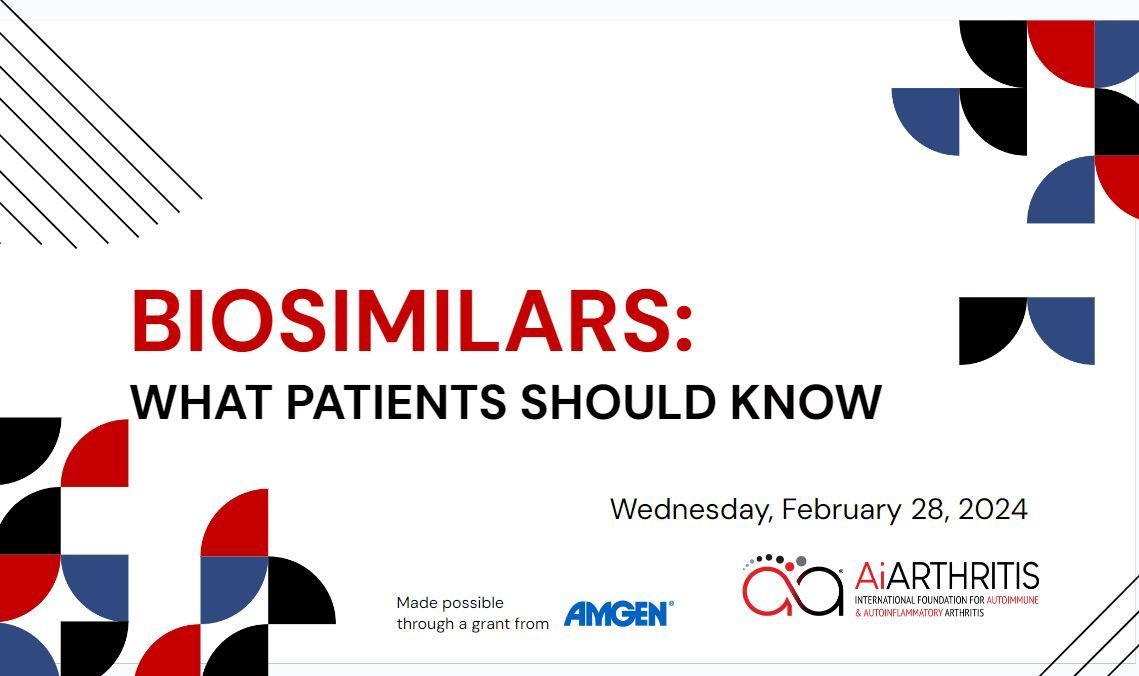
Webinar: Watch the Recording!
Biosimilars: What Patients Should Know
Biosimilars are highly similar (and potentially lower cost) alternatives to the biologic medicines commonly used to treat AiArthritis diseases.
Many health plans and governments (depending where in the world you live) are increasingly switching their patients to biosimilars to try control costs, but many physicians and patients still have concerns about switching. Then again, several patients HAVE made the switch and now can help the rest of us navigate the journey.
Watch the recording of Tiffany, AiArthritis CEO and person with Axial Spondyloarthritis, Ray, AiArthritis Patient Advocate Consultant and person with Psoriatic Arthritis, Deb and Rick - patients with rheumatoid arthritis who have switched to a biosimilar and share their experiences, and Dr. Vibeke Strand, rheumatologist - and all the conversation in the chat.
We answer a lot of your questions regarding biosimilar safety, potential "nocebo effect" (which is potentially causing a biosimilar not to work based on strong negative feelings or fear), and more.
Transcript, with all the Q and A's answered, coming soon!

AiArthritis Voices 360 Talk Show: Biosimilars - Interchangeability and Switching 2023
What do patients need to know about the upcoming changes to biosimilars and interchangeability in 2023?
In this episode, Tiffany is joined by esteemed guest experts Michael Reilly, Dr. Ralph McKibbin and Andrew Spiegel to explore the crucial distinctions between interchangeability, automatic substitution, and non-medical switching. Gain valuable insights into how these differences impact patients not only in the USA but also on a global scale.
In addition, our guests discuss the latest proposed bills in the US regarding biosimilar interchangeability, offering expert perspectives on the legislative developments and their implications for patients and healthcare providers alike.
Join us on this episode as we explore the latest updates in biosimilar interchangeability and share ways to raise your voice against non-medical switching without physician involvement.
This episode supported by:

AiArthritis Voices 360 Talk Show, Episodio 77: Biosimilares: lo que los pacientes deben saber.
Únase a Tiffany Westrich-Robertson, CEO de AiArtritis y persona que vive con espondiloartritis, mientras da la bienvenida a tres expertos: el Dr. Ralph McKibbin, Andrew Speigel y Michael Reilly, quienes desempeñan funciones destacadas en la coalición Alianza para Medicamentos Biológicos Seguros (que AiLa artritis es un ejemplo). Hoy ponemos sobre la mesa el tema de los biosimilares, pero esto es solo el comienzo.
En esta primera hora, escuche las voces de los pacientes, un médico y expertos en acceso a biosimilares y en el cambio de medicamentos, mientras debaten sobre temas importantes como qué son los biosimilares, qué es el cambio no médico (cambiar de medicamento para ahorrar costes y no por razones médicas) y mucho más. ¡No te pierdas los breves segmentos "360it" del episodio, que además continúan la conversación después del mismo!

FEATURE RESOURCE: Download the Patient Education Biosimilars Toolkit
Includes key terms to understand, questions to ask your doctor, and more. Designed and published by the World Patient Alliance and the Global Colon Cancer Association, 2022.
Other Suggested Resources:
Internacional
- La Alianza para la Seguridad de los Medicamentos Biológicos (Alliance for Safe Biologic Medicines) funciona como un centro de recursos autorizado para el público, la comunidad médica, la Administración de Alimentos y Medicamentos de los Estados Unidos (FDA) y los organismos reguladores gubernamentales de todo el mundo, a medida que se desarrollan e implementan las políticas sobre biosimilares. Más información.
- Capacitación sobre biosimilares para organizaciones de defensa del paciente (y pacientes). Capacitación virtual gratuita que ofrece herramientas para comprender mejor los biosimilares. https://learnbiosimilars.org/
Estados Unidos
- Administración de Alimentos y Medicamentos de los Estados Unidos. Más información.
- Fundación Global para una Vida Saludable/CreakyJoints "Guía para pacientes sobre la comprensión de los biosimilares"Más información.
- Fundación de Artritis Más información.
- El Colegio Americano de Reumatología (ACR) sobre los biosimilares.
Más información.
Canadá
- Biosim•Exchange, un programa de Arthritis Consumer Experts (ACE)/JointHealth donde podrá obtener las últimas noticias y análisis sobre biosimilares. Más información.
- Health Canada es el departamento federal responsable de ayudar a los canadienses a mantener y mejorar su salud, respetando las decisiones y circunstancias individuales. También es responsable de la regulación de los biosimilares en Canadá.
Más información.
- Agencia Europea de Medicamentos (EMA). La Agencia es responsable de evaluar las solicitudes de las empresas para comercializar medicamentos biológicos para su uso en la Unión Europea (UE), incluidos los medicamentos biosimilares. La Comisión Europea emite decisiones sobre la autorización de biosimilares basándose en los dictámenes científicos de la EMA. Más información.
- Posición de la Liga Europea contra el Reumatismo (EULAR) sobre los biosimilares. Más información.
- La Alianza Global para el Acceso de los Pacientes (GAfPA, por sus siglas en inglés) es la Red Internacional de Médicos y Defensores del Acceso de los Pacientes, que trabaja principalmente en Europa, América Latina, Asia y Australia.
Más información.
- El Departamento de Salud del Gobierno australiano/el Programa de Prestaciones Farmacéuticas (PBS, por sus siglas en inglés) del Gobierno australiano proporciona acceso fiable, oportuno y asequible a una amplia gama de medicamentos para todos los australianos.
Más información.
Europa
Australia
Thank you to our program sponsors: